Has the Real Cost of Business Class Gone Up or Down?

Business class has spent the last three decades transforming from a slightly fancy economy seat with a cloth headrest cover into a flying hotel room with sliding doors, à la carte dining and enough storage to bring all your luggage as carry-on. The question is whether the real cost of business class has kept pace with that transformation, or leapt into a different price bracket altogether.

To answer it properly, we need to look at two iconic long-haul routes: London–New York, the world’s most competitive premium market, and London–Hong Kong, a marathon sector where the big Asian carriers forced everyone to up their game.

London-New York: where prices moved in opposite directions

In 1991, during a transatlantic fare war, analysts quoted a typical business class return at about $1,350, which lands around $3,000–$3,200 in today’s money. That got you a big recliner, a marked improvement on economy, and a light sprinkling of 90s glamour.

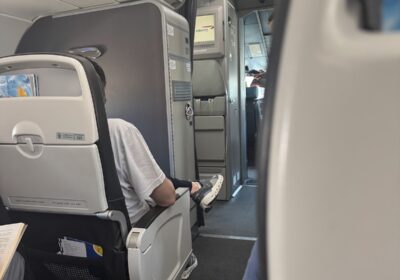
The 1990s transatlantic business class seat looked a lot like today's premium economy (Source: British Airways)
The 1990s transatlantic business class seat looked a lot like today’s premium economy
(Source: British Airways)

Jump to today and the fully flexible fare for this route commonly sits between $4,500 and $7,000, with busy corporate dates climbing even higher. On paper, it’s an obvious real-terms increase, but that’s only half the story.

Over the past three decades, airlines have learned how to sell the same business-class seat at very different prices depending on timing, restrictions and willingness to give up flexibility. Once you step away from fully flexible fare buckets and into the heavily restricted tickets aimed at advance-booking leisure travellers, the numbers change quickly.

The leisure traveller’s reality:

  • Regular sales price return tickets between $1,500 and $2,000.
  • Ex-Europe tricks (Dublin, Oslo, Amsterdam) routinely push that to $1,100–$1,600.
  • Using a companion voucher or miles lowers the cash element dramatically.

Compared to the early-90s inflation-adjusted benchmark of roughly $3,000, this means something slightly surprising: Discounted business class seats to New York are often cheaper today than they were 30 years ago.

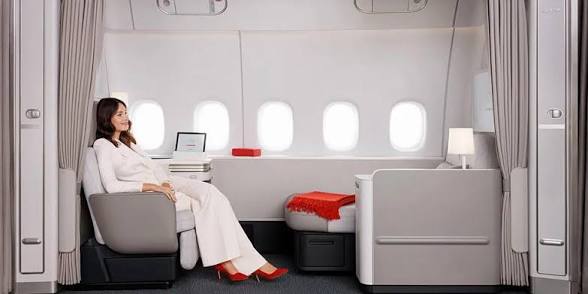
The first generation British Airways lie-flat Club World seat (Source: British Airways)

Meanwhile, the product has improved beyond recognition: flat beds, sliding doors, Wi-Fi, and lounges that look more like boutique hotels. London–New York is the clearest example of a market where corporate fares inflated, but leisure fares deflated.

London–Hong Kong: premium cabins got pricier, and stayed that way

Hong Kong followed a different trajectory. In the early 1990s, a typical business class return from London cost around $3,500–$4,500, equal to roughly $7,000–$8,500 today. Still expensive, but proportionate to other very long sectors.

Then Asia’s premium carriers pushed business class into a new league. Cathay Pacific and Singapore Airlines upgraded to flat beds early. Middle Eastern carriers began offering suites, dine-on-demand and onboard lounges. The benchmark for “business class comfort” rose every year, and naturally, so did the price.

Today’s full-fare reality:

  • Standard flexible returns sit between $7,500 and $11,000.
  • Peak dates can exceed $12,000.

Even sale fares don’t drop as enthusiastically as they do on JFK:

  • European carriers often land sale fares around $2,700–$3,500.
  • Exceptional Middle Eastern promotions hover between $2,000 and $2,500, and even those are rare.

Compared to the inflation-adjusted 1990s range ($7,000–$8,500), Hong Kong stands out as a route where business class has become more expensive in real terms, even when discounted.

Business class has improved beyond recognition, but accessing it now requires a much bigger outlay.

Why these routes diverged

London–New York is possibly the most competitive premium corridor in aviation. Six major airlines fight for the same high-yield market, so deep discounting is a recurring tactic. That competition drags down the real price that many travellers pay.

London–Hong Kong, meanwhile, sits at the luxury end of long-haul aviation:

  • Longer flight duration → higher costs
  • Asian and Middle Eastern carriers treat business class as a flagship product
  • Demand stays consistently high and capacity is lower than on transatlantic routes
  • Sales happen, but floor prices stay firm
  • The cabins themselves have evolved further than almost any other region

The New York route encourages aggressive discounting. The Hong Kong route encourages product escalation.

It’s true that some of the biggest breakthroughs in business class appeared first on transatlantic routes. British Airways launched the first fully flat business seat on London–New York in 2000, and Virgin Atlantic spent much of the 1990s redefining what a premium cabin could look like. But invention isn’t the same as escalation. The New York market worked as a test lab because flights were short enough to absorb risk and competition was intense enough to reward experimentation. What it didn’t reward was sustained pricing power. Any improvement was quickly matched, then undercut. Asia-Pacific routes, particularly London–Hong Kong, were different. Longer sectors amplified the value of sleep, premium demand supported higher floor prices, and carriers like Cathay Pacific and Singapore Airlines competed on quality rather than discounting. Transatlantic routes may have delivered the first lie-flat seat, but Asian routes turned it into a private suite and proved passengers would pay for continual upgrades.

So… has business class become more or less expensive?

The honest answer depends on which fare bucket you’re talking about, and whether you’re travelling on someone else’s balance sheet or your own.

For corporate travellers buying fully flexible business class tickets, usually booked into high-yield fare classes with minimal restrictions, the real cost has almost certainly increased since the early 1990s. These fares prioritise flexibility over price: changeable at short notice, refundable, and often tied to corporate contracts. They are designed for travellers who value time and certainty above all else, and airlines price them accordingly. In return, the product is vastly better than it was 30 years ago, with fully flat beds, privacy, reliable connectivity and lounge networks that barely resemble their 1990s counterparts.

Leisure travellers sit at the other end of the pricing spectrum, and this is where modern price discrimination becomes obvious. Airlines now sell the same physical seat across a wide range of fare buckets, from expensive flexible tickets down to tightly restricted promotional fares that are non-refundable, non-changeable, and sold well in advance. On routes like London–New York, this has pushed the real cost of leisure business class down, with discounted fares often undercutting what an inflation-adjusted business ticket would have cost in the early 1990s. The catch is flexibility: you pay less because you give the airline certainty.

London–Hong Kong behaves differently. Even in lower business-class fare buckets, discounted tickets rarely fall below their historic, inflation-adjusted equivalents. The longer flight time, higher operating costs and more premium-focused competition keep a firm price floor in place. Sales exist, but the gap between restricted leisure fares and fully flexible corporate fares is narrower than on transatlantic routes.

The bigger picture is that business class pricing has diverged. Airlines now extract maximum value from time-sensitive corporate travellers through high-yield fare classes, while simultaneously using heavily restricted fares to fill the same cabin with leisure passengers who would never pay the headline price. Three decades ago, business class sat closer to full-fare economy in pricing terms, positioned as a premium but not a separate luxury tier, built around a reclining seat and better service. Today it’s a lie-flat suite with Wi-Fi, sold at radically different prices depending on how much flexibility you’re prepared to give up – and on the highly competitive routes, that means flying in far more comfort for less money than it would have cost in 1991.

For more on business class seat pricing, read How much should you pay for a Business Class seat?

Don’t forget to sign-up to our weekly newsletter to get our latest updates delivered straight to your inbox.

Leave a Reply

Your email address will not be published. Required fields are marked *