Global Airlines, the ambitious British start-up founded by former travel blogger James Asquith, has been ordered into compulsory liquidation by the High Court in London. The winding-up order, made on 4 November 2026, follows a creditor petition filed in May and brings a rather unceremonious conclusion to an airline that promised to transform long-haul travel.
We first wrote about Global Airlines in August 2023, when Asquith was promising a fleet of enormous Airbus A380s, luxurious cabins and a new approach to flying across the Atlantic. We were intrigued, although we questioned whether the economics would work.
Three years later, the airline’s entire passenger operation amounts to two return flights to New York, neither operated under its own air operator certificate.
The company’s ambitions were certainly global. Its actual route network was rather more modest.
From Travel Blogger To Airline CEO
James Asquith wasn’t your typical airline founder. He became well known as the youngest person to visit every country in the world, building a following through travel blogging and social media before launching the accommodation platform Holiday Swap.
In 2021, he founded Global Airlines with plans to challenge established transatlantic carriers, including British Airways and Virgin Atlantic. The idea was to revive the supposed golden age of flying, with better food, luxurious cabins and more attentive service.
The centrepiece was an all-Airbus A380 fleet. Global announced plans to acquire four secondhand superjumbos, a bold choice when much of the industry was moving towards smaller, more economical twin-engine aircraft.
There were even plans for a frequent flyer programme called Global Aviator and a partnership with American Express. We wondered whether the airline could attract enough passengers, secure suitable airport slots and obtain the necessary regulatory approvals.
As it turns out, those were fairly reasonable questions.
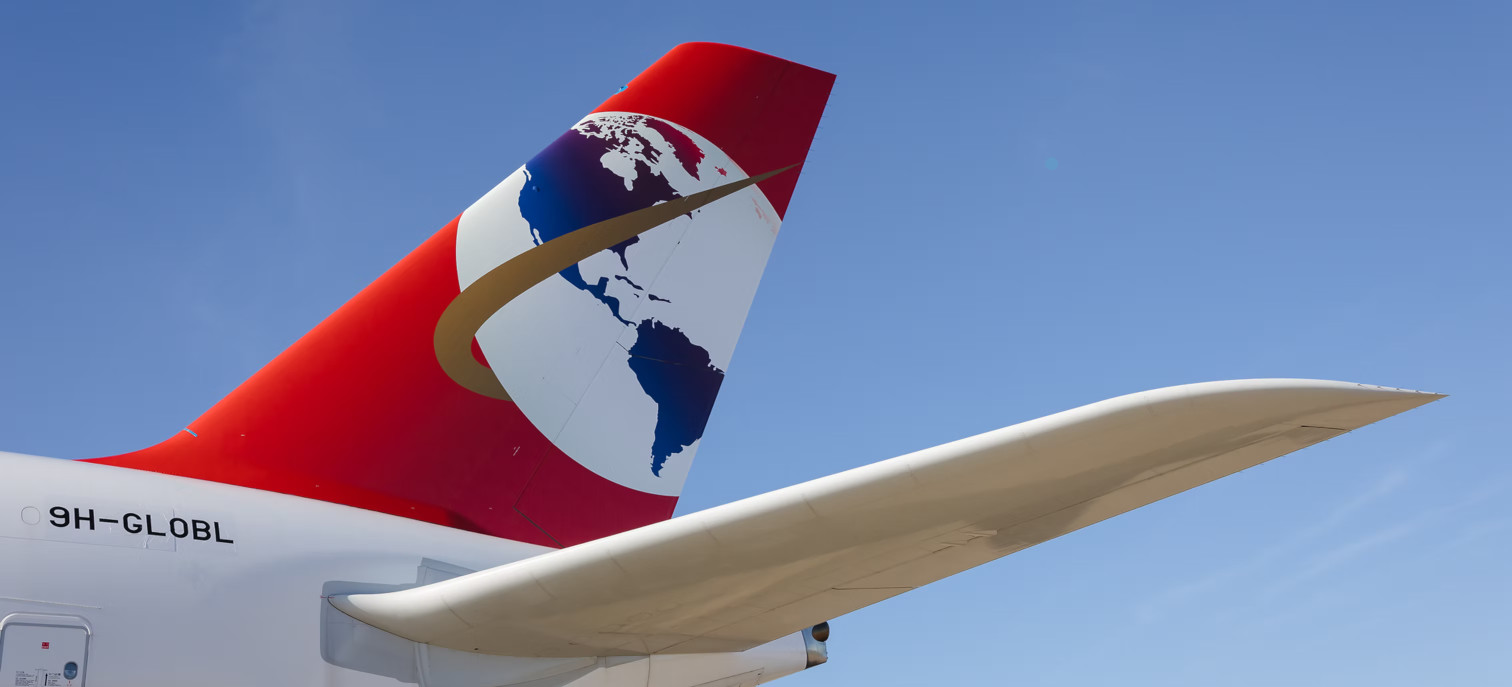
Global Airlines logo
Four Flights, One Aircraft & No Airline Licence
Global originally targeted summer 2024 for its first scheduled transatlantic services. That date came and went, with the company continuing to publicise progress on its aircraft refurbishment and launch preparations.
Eventually, in May 2025, something remarkable happened. The airline actually carried passengers.
On 15 May, its Airbus A380 departed Glasgow for New York JFK, returning four days later. A second return trip followed from Manchester on 21 May, with passengers arriving back in the UK on 25 May.
There was, however, a fairly significant catch.
Global Airlines had never obtained its own air operator certificate (AOC), the approval that allows an airline to conduct commercial flights. Instead, it relied on established charter operator Hi Fly Malta to operate its aircraft and carry the passengers.
The flights were effectively one-off charter services, rather than the launch of the scheduled transatlantic network the company had spent years promoting.
Still, we have to give Global some credit. Plenty of critics doubted it would ever carry a paying passenger, and it managed to prove them wrong.
Unfortunately, that’s about where the aviation achievements ended.
A Golden Age That Never Quite Arrived
The launch flights attracted considerable attention from aviation enthusiasts, journalists and social media personalities. Some praised the onboard catering, champagne and enthusiastic cabin crew. Others reported slow service, dated cabin fittings and broken inflight entertainment systems.
Rather than introducing a revolutionary new cabin, Global’s A380 largely retained the interior inherited from its previous operator, China Southern Airlines.
The first flight also struggled to fill the enormous aircraft. Reports described a lightly loaded A380, while economy return fares were reduced substantially from their initial advertised prices.
To be fair, an inaugural charter flight isn’t a reliable test of long-term demand. Nor should anyone expect an entirely new airline to deliver flawless service on its first day. Global also received positive feedback for its food and some elements of its premium cabins.
But the airline was selling a return to the golden age of aviation. What passengers received was a secondhand superjumbo, operated by another airline, with a rather mixed cabin product.
After the Manchester return flight, there were no further passenger services.
On 16 July 2025, the aircraft arrived at Tarbes-Lourdes-Pyrénées Airport in southern France, a facility associated with aircraft storage and maintenance. It has remained there ever since.
Global Airlines A380 with dark skies (source: Aiden Cassidy)
Creditors Finally Lose Patience
While Global Airlines continued to suggest that flying would resume, its financial and legal difficulties were becoming harder to ignore, and its financial backers began calling for liquidation.
The company faced winding-up petitions in August 2025 and March 2026, both of which were subsequently withdrawn. A third petition followed on 29 May 2026, brought by creditor Jessica Huffman Reese.
The case passed through several hearings, including proceedings in September, when the court adjourned the petition rather than immediately winding up the company.
The order places the company into liquidation, transferring control of its affairs away from the directors and into the insolvency process. The liquidator is responsible for dealing with the company’s assets, investigating its affairs and addressing creditors’ claims.
There’s another curious detail in Global Airlines’ corporate records. Despite spending years promoting itself as a passenger airline, its sole registered business activity at Companies House was SIC 46140: ‘Agents involved in the sale of machinery, industrial equipment, ships and aircraft’.
For comparison, commercial passenger airlines normally fall under SIC 51101 (scheduled passenger air transport) or 51102 (non-scheduled passenger air transport).
A SIC code doesn’t determine whether a company can operate flights, and Global may have structured its business around aircraft ownership or related commercial activities. Nevertheless, it’s an unusual classification for a company whose public ambition was to revolutionise transatlantic passenger travel.
Even on paper, Global Airlines wasn’t classified as a passenger airline.
The A380 Was Always A Huge Gamble
We’ve always had a soft spot for the Airbus A380. The aircraft is spacious, quiet and, in the hands of airlines such as Emirates and Singapore Airlines, capable of delivering a fantastic premium cabin product.
But wonderful aircraft don’t automatically make profitable airlines.
The A380 has four engines, high operating costs and hundreds of seats to fill. Established airlines can spread these costs across substantial networks, large fleets and established passenger bases. They also have the financial resources and operational flexibility to manage lengthy maintenance visits.
Global was trying to establish a new airline around one enormous aircraft, without an existing customer base, established route network or its own operating certificate.
Even the best onboard catering couldn’t overcome those challenges.
There was another fundamental problem. Global wanted to compete against British Airways and Virgin Atlantic on one of the most competitive long-haul markets in the world. Both already have extensive networks, established loyalty programmes, corporate travel contracts and valuable airport slots.
A start-up can certainly compete with established airlines, but it needs a credible advantage in cost, convenience or product quality.
An ageing A380 and a promise to make flying glamorous again never looked like enough.
Global Airlines A380 press shot
Our Verdict: Big Ambitions, Very Little To Show
We don’t take pleasure in seeing another aviation business collapse. Launching an airline is extraordinarily difficult, and the industry could certainly benefit from more competition, particularly in the premium transatlantic market.
Asquith deserves some credit for attempting something ambitious. He managed to acquire an A380, get it flying again and carry passengers across the Atlantic. That’s considerably further than many proposed airlines ever get.
But ambition alone doesn’t make a viable business.
When we first covered Global Airlines in 2023, we wondered whether its plans were financially and operationally realistic. Three years later, the airline has never established scheduled services, obtained its own operating certificate or built the fleet it promised.
Global Airlines’ single operational A380 has spent well over a year parked in France burning cash, while the company has ended up in compulsory liquidation following creditor action.
Perhaps the most remarkable part of the story is how much publicity Global Airlines generated for an airline that managed only four passenger flights.


Global Airlines, the ambitious British start-up founded by former travel blogger James Asquith, has been ordered into compulsory liquidation by the High Court in London. The winding-up order, made on 4 November 2026, follows a creditor petition filed in May and brings a rather unceremonious conclusion to an airline that promised to transform long-haul travel.
We first wrote about Global Airlines in August 2023, when Asquith was promising a fleet of enormous Airbus A380s, luxurious cabins and a new approach to flying across the Atlantic. We were intrigued, although we questioned whether the economics would work.
Three years later, the airline’s entire passenger operation amounts to two return flights to New York, neither operated under its own air operator certificate.
The company’s ambitions were certainly global. Its actual route network was rather more modest.
From Travel Blogger To Airline CEO
James Asquith wasn’t your typical airline founder. He became well known as the youngest person to visit every country in the world, building a following through travel blogging and social media before launching the accommodation platform Holiday Swap.
In 2021, he founded Global Airlines with plans to challenge established transatlantic carriers, including British Airways and Virgin Atlantic. The idea was to revive the supposed golden age of flying, with better food, luxurious cabins and more attentive service.
The centrepiece was an all-Airbus A380 fleet. Global announced plans to acquire four secondhand superjumbos, a bold choice when much of the industry was moving towards smaller, more economical twin-engine aircraft.
There were even plans for a frequent flyer programme called Global Aviator and a partnership with American Express. We wondered whether the airline could attract enough passengers, secure suitable airport slots and obtain the necessary regulatory approvals.
As it turns out, those were fairly reasonable questions.
Four Flights, One Aircraft & No Airline Licence
Global originally targeted summer 2024 for its first scheduled transatlantic services. That date came and went, with the company continuing to publicise progress on its aircraft refurbishment and launch preparations.
Eventually, in May 2025, something remarkable happened. The airline actually carried passengers.
On 15 May, its Airbus A380 departed Glasgow for New York JFK, returning four days later. A second return trip followed from Manchester on 21 May, with passengers arriving back in the UK on 25 May.
There was, however, a fairly significant catch.
Global Airlines had never obtained its own air operator certificate (AOC), the approval that allows an airline to conduct commercial flights. Instead, it relied on established charter operator Hi Fly Malta to operate its aircraft and carry the passengers.
The flights were effectively one-off charter services, rather than the launch of the scheduled transatlantic network the company had spent years promoting.
Still, we have to give Global some credit. Plenty of critics doubted it would ever carry a paying passenger, and it managed to prove them wrong.
Unfortunately, that’s about where the aviation achievements ended.
A Golden Age That Never Quite Arrived
The launch flights attracted considerable attention from aviation enthusiasts, journalists and social media personalities. Some praised the onboard catering, champagne and enthusiastic cabin crew. Others reported slow service, dated cabin fittings and broken inflight entertainment systems.
Rather than introducing a revolutionary new cabin, Global’s A380 largely retained the interior inherited from its previous operator, China Southern Airlines.
The first flight also struggled to fill the enormous aircraft. Reports described a lightly loaded A380, while economy return fares were reduced substantially from their initial advertised prices.
To be fair, an inaugural charter flight isn’t a reliable test of long-term demand. Nor should anyone expect an entirely new airline to deliver flawless service on its first day. Global also received positive feedback for its food and some elements of its premium cabins.
But the airline was selling a return to the golden age of aviation. What passengers received was a secondhand superjumbo, operated by another airline, with a rather mixed cabin product.
After the Manchester return flight, there were no further passenger services.
On 16 July 2025, the aircraft arrived at Tarbes-Lourdes-Pyrénées Airport in southern France, a facility associated with aircraft storage and maintenance. It has remained there ever since.
Creditors Finally Lose Patience
While Global Airlines continued to suggest that flying would resume, its financial and legal difficulties were becoming harder to ignore, and its financial backers began calling for liquidation.
The company faced winding-up petitions in August 2025 and March 2026, both of which were subsequently withdrawn. A third petition followed on 29 May 2026, brought by creditor Jessica Huffman Reese.
The case passed through several hearings, including proceedings in September, when the court adjourned the petition rather than immediately winding up the company.
That changed on 4 November 2026, when the High Court issued a compulsory winding-up order against Global Airlines Ltd.
The order places the company into liquidation, transferring control of its affairs away from the directors and into the insolvency process. The liquidator is responsible for dealing with the company’s assets, investigating its affairs and addressing creditors’ claims.
There’s another curious detail in Global Airlines’ corporate records. Despite spending years promoting itself as a passenger airline, its sole registered business activity at Companies House was SIC 46140: ‘Agents involved in the sale of machinery, industrial equipment, ships and aircraft’.
For comparison, commercial passenger airlines normally fall under SIC 51101 (scheduled passenger air transport) or 51102 (non-scheduled passenger air transport).
A SIC code doesn’t determine whether a company can operate flights, and Global may have structured its business around aircraft ownership or related commercial activities. Nevertheless, it’s an unusual classification for a company whose public ambition was to revolutionise transatlantic passenger travel.
Even on paper, Global Airlines wasn’t classified as a passenger airline.
The A380 Was Always A Huge Gamble
We’ve always had a soft spot for the Airbus A380. The aircraft is spacious, quiet and, in the hands of airlines such as Emirates and Singapore Airlines, capable of delivering a fantastic premium cabin product.
But wonderful aircraft don’t automatically make profitable airlines.
The A380 has four engines, high operating costs and hundreds of seats to fill. Established airlines can spread these costs across substantial networks, large fleets and established passenger bases. They also have the financial resources and operational flexibility to manage lengthy maintenance visits.
Global was trying to establish a new airline around one enormous aircraft, without an existing customer base, established route network or its own operating certificate.
Even the best onboard catering couldn’t overcome those challenges.
There was another fundamental problem. Global wanted to compete against British Airways and Virgin Atlantic on one of the most competitive long-haul markets in the world. Both already have extensive networks, established loyalty programmes, corporate travel contracts and valuable airport slots.
A start-up can certainly compete with established airlines, but it needs a credible advantage in cost, convenience or product quality.
An ageing A380 and a promise to make flying glamorous again never looked like enough.
Our Verdict: Big Ambitions, Very Little To Show
We don’t take pleasure in seeing another aviation business collapse. Launching an airline is extraordinarily difficult, and the industry could certainly benefit from more competition, particularly in the premium transatlantic market.
Asquith deserves some credit for attempting something ambitious. He managed to acquire an A380, get it flying again and carry passengers across the Atlantic. That’s considerably further than many proposed airlines ever get.
But ambition alone doesn’t make a viable business.
When we first covered Global Airlines in 2023, we wondered whether its plans were financially and operationally realistic. Three years later, the airline has never established scheduled services, obtained its own operating certificate or built the fleet it promised.
Global Airlines’ single operational A380 has spent well over a year parked in France burning cash, while the company has ended up in compulsory liquidation following creditor action.
Perhaps the most remarkable part of the story is how much publicity Global Airlines generated for an airline that managed only four passenger flights.
Related Articles
BA Changes Club Tier Points Thresholds Again
Air France Wins Best First Class: Does It Beat Emirates?
Singapore Airlines’ New Amenity Kits (but don’t mention the new seats)
British Airways promises a new era of luxury. Can it actually deliver?