


Hotel loyalty programmes are a study in scale versus depth. This Marriott Bonvoy review looks at the world’s largest hotel loyalty programme – more than 30 brands and over 9,700 properties across 143 countries, including Ritz-Carlton, St. Regis, W, Sheraton, Westin, JW Marriott, Le Méridien, and EDITION. The footprint is unmatched. The execution? Patchy. For UK travellers, though, Marriott Bonvoy has practical advantages over Hyatt and Hilton that punch above first impressions – a proper UK Amex credit card, two co-branded debit cards, and one of the more rewarding hotel-to-Avios transfer routes available to British Airways Club members.
Points Earning Rates On Stays
Marriott uses a base earning structure that varies by brand. At most full-service brands – Marriott, JW Marriott, Sheraton, Westin, Le Méridien, Renaissance, Autograph Collection, and the luxury portfolio (Ritz-Carlton, St. Regis, W, EDITION, Luxury Collection) – you earn 10 base points per US dollar. Several select-service brands also earn at 10 points per dollar, including Courtyard, Four Points, Fairfield, AC Hotels, Aloft, Moxy, and citizenM.
Several longer-stay and budget brands earn less:
5 points per dollar with one full Elite Night Credit per night: Residence Inn, TownePlace Suites, Element, Marriott Executive Apartments, Homes & Villas, and Apartments by Marriott Bonvoy.
5 points per dollar but only 0.5 Elite Night Credit per night: Protea Hotels, City Express, Four Points Flex, and Series by Marriott.
4 points per dollar and zero Elite Night Credits: StudioRes, Marriott’s newest budget extended-stay brand. You can stay there but it won’t count toward your status, because apparently Marriott looked at loyalty and thought: what if less?
Elite bonuses stack on top. Silver adds 10%, Gold 25%, Platinum 50%, Titanium 75%, and Ambassador 75%. A Platinum member at a full-service Marriott earns 15 points per dollar; a Titanium or Ambassador earns 17.5.
For UK readers, Marriott Bonvoy points are worth roughly 0.55p each in everyday redemptions, with the best luxury redemptions pushing value to 1p per point or above. The average is firmly mid-tier.
How Easy Is It To Redeem Points For Stays & Upgrades?
Marriott eliminated its published award chart in March 2022 and moved to fully dynamic pricing. Award costs now move with cash rates, with no published categories and no fixed peak or off-peak rates.
In practice, standard room redemptions range from around 5,000 points at cheaper properties to 150,000+ points at flagship luxury resorts during peak periods. Top-end properties like the Ritz-Carlton Maldives and St. Regis Bora Bora can hit 150,000 points per night at peak times, although Marriott appears to operate a soft ceiling around that level – which creates real arbitrage at properties where cash rates exceed £1,500 per night.
The standout redemption mechanic – and the single most important point in any Marriott Bonvoy review – is what Marriott calls “Stay for 5, Pay for 4”, although everyone else still calls it fifth night free because we have lives. Book 5 or more consecutive award nights and Marriott waives the cost of the lowest-priced night automatically. On a 10-night stay, the two cheapest nights come off. This is the highest-ROI redemption tool in the programme, available to all members, and applies to standard and PointSavers awards. It doesn’t apply to Free Night Awards or Cash + Points stays.
Two other features worth knowing. Free Night Awards issued by credit cards (25K, 35K, 50K, or 85K certificates) can be topped up with up to 25,000 points as of March 2026 – up from 15,000 previously, which expands what you can book substantially. Nightly Upgrade Awards (formerly Suite Night Awards) can be applied to premium room or suite upgrades, with Marriott checking availability five days before arrival for most brands (three days for EDITION, Ritz-Carlton, and St. Regis) – which explains why they can feel both brilliant and maddeningly useless depending on the property.
Marriott operates a “Limited Blackout Dates” policy rather than a pure no-blackout promise. Standard room awards should usually be available when standard rooms are sold for cash, but properties can limit redemption inventory on certain dates.
Do Points Expire?
Yes. Marriott Bonvoy points expire after 24 months of account inactivity. Any qualifying earning or redemption activity resets the 24-month clock – a paid stay, a credit card purchase, a partner transfer, or a redemption.
For UK travellers, the easiest way to keep points alive is a small amount of spend on the UK Marriott Bonvoy Amex or one of the Currensea debit cards, or a transfer from American Express Membership Rewards. The Currensea debit card activity counts toward Marriott’s 24-month requirement, which makes it a useful passive backstop for occasional Marriott users.
Introduction To The Status Tiers
Any Marriott Bonvoy review has to spend a bit of time on the tier structure, because the gap between the entry-level perks and the truly useful ones is large. Marriott Bonvoy operates five elite tiers above basic membership: Silver, Gold, Platinum, Titanium, and Ambassador. There are also three lifetime status tiers available – more on those later.
Silver Elite is the entry-level tier, earned after 10 qualifying nights. The benefits are cosmetic: 10% points bonus, priority late checkout, and free Wi-Fi (which all members get anyway). Honestly, Silver barely qualifies as elite status.
Gold Elite at 25 nights starts to deliver. You get a 25% points bonus, 2pm late checkout subject to availability, upgrades to a better room category (no suites), and a 250 or 500-point welcome gift at check-in. Gold also comes complimentary with the UK Amex Platinum Card.
Platinum Elite at 50 nights is where the programme gets serious. Breakfast or lounge access at many brands, 4pm guaranteed late checkout, upgrades including some suites, 50% points bonus, executive lounge access at participating brands, and the first Annual Choice Benefit. Platinum is widely regarded as the elite sweet spot – the benefits actually deliver, the qualification is achievable, and you’re not chasing diminishing returns.
Titanium Elite at 75 nights adds a second Annual Choice Benefit (which can include a Free Night Award worth up to 40,000 points), 75% points bonus, 48-hour room availability guarantee, complimentary United MileagePlus Premier Silver, and Air Canada Aeroplan 25K status. The jump from Platinum to Titanium is real but incremental.
Ambassador Elite is the top tier, requiring 100 qualifying nights AND $23,000 (£17,250 / €20,000) in eligible spend. Both conditions must be met. Benefits include Ambassador Service (a dedicated concierge) and Your24 (the ability to choose your own 24-hour check-in/checkout window). Reports on Ambassador are notably mixed – some long-term members say the practical upgrade over Titanium is minimal.
Tier Point Accrual Rates On Stays
Marriott uses Elite Night Credits (ENCs) to track qualification. One paid night earns one ENC at most brands, with the exceptions noted earlier in this Marriott Bonvoy review (half ENCs at Protea, City Express, Four Points Flex, and Series by Marriott; zero ENCs at StudioRes). Credit cards and select promotions also award ENCs.
Qualification thresholds are calendar-year based, running 1 January to 31 December. Status is valid for the remainder of the qualifying year, the full following year, and through February of the year after that.
The requirements are:
- Silver Elite: 10 ENCs
- Gold Elite: 25 ENCs
- Platinum Elite: 50 ENCs
- Titanium Elite: 75 ENCs
- Ambassador Elite: 100 ENCs PLUS $23,000 (£17,250 / €20,000) in eligible spend
Third-party bookings through OTAs (Booking.com, Expedia, Hotels.com) earn no points and no ENCs, and elite benefits don’t apply to OTA bookings either – more restrictive than Radisson’s approach. Marriott has also confirmed a soft-landing policy for 2026: members who don’t requalify in 2025 will be granted the status one tier below their current level through February 2027.

Approximate Cost & Nights Required To Reach Top Status
Reaching Platinum is achievable for any regular traveller. At 50 nights it sits at the same threshold as Hilton Diamond and below Hyatt Globalist (60 nights). That implies roughly $7,500-$15,000 (£5,625-£11,250 / €6,525-€13,050) in eligible Marriott spend depending on brand and city.
Titanium at 75 nights is a real step up but not absurd. UK credit card holders can shortcut this significantly – more on the card strategy below.
Ambassador Elite is firmly road-warrior territory. 100 nights plus $23,000 (£17,250 / €20,000) in spend translates to an average nightly rate of $230 (£172 / €200) across 100 nights. The spend requirement is the real gate. Most Platinum and Titanium members never come close.
Sweet-Spot For Earning Status
For UK travellers, Marriott Bonvoy has one of the most accessible accelerator paths of any major hotel programme – largely thanks to real UK products that don’t exist for Hyatt or (in credit card form) for Radisson. This is where this Marriott Bonvoy review gets most useful for UK readers.
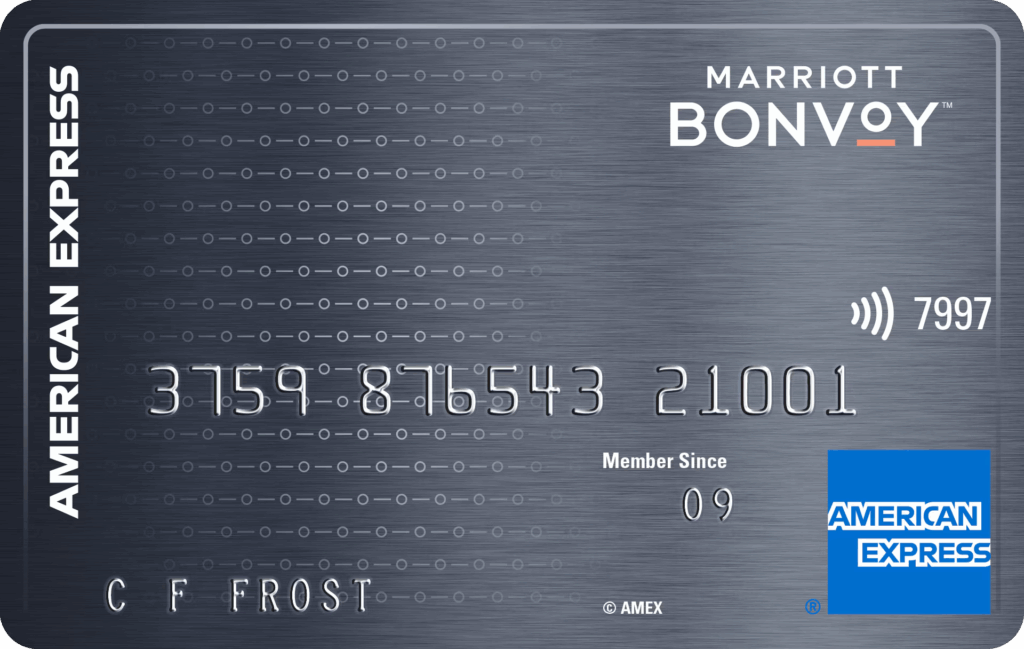
The UK Marriott Bonvoy American Express Card (£95 annual fee) is the cornerstone. You get automatic Silver status, 15 Elite Night Credits per year, an automatic upgrade to Gold after £15,000 of card spend in a calendar year, a free night certificate (up to 25,000 points) after £25,000 of annual spend, and 2 points per £1 on general spending (6 points per £1 at participating Marriott Bonvoy hotels).
The UK Marriott Bonvoy Premium Debit Card (£175 annual fee, issued by Currensea) is the more interesting of the two debit options. It grants automatic Gold Elite status for as long as you hold the card – matching what UK Amex Platinum holders get, but as a much cheaper standalone route to Gold. You also get 15 Elite Night Credits per year, plus 1 additional ENC for every £4,000 in eligible spend (capped at 5 extra ENCs). Earning rates run 1.5 points per £1 on UK and European general spend, 3 points per £1 elsewhere, 4 points per £1 at UK Marriott hotels, and 6 points per £1 at Marriott hotels outside the UK. There’s also a free night certificate (up to 25,000 points, or 50,000 if you spend over £9,500 in foreign currency annually).
There’s also a standard Marriott Bonvoy Debit Card at £55 per year – the more accessible entry point. It grants automatic Silver Elite status, 10 Elite Night Credits per year (plus up to 5 more from £4,000+ in spend), and earns at lower rates than the Premium card.
Stacking the cards is the real UK power move. Holding both the Amex Credit Card and the Premium Debit Card gives 30 ENCs per year before any spend – plus automatic Gold status from day one. With enough debit card spend to trigger the extra ENCs, you can hit 35 ENCs from cards alone. At 35 ENCs, Platinum needs just 15 actual stays, and Titanium needs around 40.
Status match and fast tracks. Marriott does not usually publish a broad hotel status match. There are targeted and partner-specific fast tracks – including the Miles & More partnership where eligible members can receive Marriott status benefits – but don’t build a strategy around it unless you can see an active offer.
For points accumulation rather than status, the UK Amex Membership Rewards transfer ratio is 2:3 (1,000 MR = 1,500 Bonvoy). That’s a stronger hotel transfer than Hilton (1:2) on a per-point value basis. Airline partner transfers usually still beat both.
Overall Quality Of The Status Benefits
Marriott’s elite benefits are extensive on paper but inconsistent in delivery. Two Platinum members staying at two different Marriott-branded hotels in the same city can have radically different outcomes on breakfast, lounge access, and upgrades. The variability is the programme’s most-criticised feature.
Silver and Gold deliver the cosmetic benefits already covered in the tier section. The real action starts at Platinum.
Platinum Elite is where Marriott starts to compete with Hilton Diamond and Hyatt Globalist. The headline benefits are:
Breakfast or lounge access – annoyingly brand-specific. At brands with executive lounges (Sheraton, Westin, Marriott, Le Méridien, Renaissance, and others), Platinum members get full lounge access plus complimentary continental breakfast. At brands without lounges, the welcome gift may be a food and beverage credit or restaurant breakfast.
Execution varies significantly. At JW Marriott, Marriott Hotels, Renaissance, and Autograph Collection in the US, Canada, and Europe, the welcome gift is 1,000 points or a US$10 food and beverage credit per stay, with resorts adding restaurant breakfast as an option. Notable exclusions include Ritz-Carlton, St. Regis, W, EDITION, Renaissance Resorts, Marriott Vacation Club, and Marriott Executive Apartments. Asia and Europe generally honour the benefit more consistently than North America.
Guaranteed 4pm late checkout at most properties (resorts and convention hotels are exceptions). Unlike Hilton’s similar benefit, this is contractual rather than subject to availability at most brands.
Upgrades including some suites where available at check-in. Reports on actual upgrade success rates are mixed – Platinum-level suite upgrades happen, but less reliably than at Hyatt.
Annual Choice Benefit earned at 50 ENCs. Options include 5 Nightly Upgrade Awards, gifting Silver status to another member, $1,000 off a Marriott Bed mattress, a $100 charity donation, or 5 additional Elite Night Credits.
Titanium Elite layers on a 75% points bonus, a second Annual Choice Benefit (which includes a Free Night Award worth up to 40,000 points – properly valuable), 48-hour booking guarantee, and the United and Aeroplan airline status benefits noted earlier. The free night award alone can be worth £200-£400 if used at a premium property.
Ambassador Elite adds Your24 and a personal Ambassador concierge. The practical value depends entirely on how good your assigned Ambassador is – reports range from “transformational” to “completely absent.”
Lifetime status is a key differentiator versus Hyatt and Hilton. Marriott offers Lifetime Silver (250 nights + 5 years), Lifetime Gold (400 nights + 7 years), and Lifetime Platinum (600 nights + 10 years). Lifetime Titanium was discontinued in 2018 and is no longer earnable.
The biggest critique of Marriott’s elite programme is execution variance. The benefits look good written down, but property-by-property delivery is uneven. Asian and European Marriott properties tend to honour benefits more consistently than North American ones – which is the case for most UK travellers.
BG1 Verdict
Marriott Bonvoy is the world’s largest hotel loyalty programme, and for many UK travellers, it’s the one that makes the most pragmatic sense. The footprint is unmatched, and the UK credit card and debit card combination delivers real status acceleration that few other programmes can match.
Where does this Marriott Bonvoy review land competitively? The footprint is the strongest of any major hotel programme, elite status is easier to earn (with UK cards) than at Hyatt, the elite benefit consistency is weaker than Hyatt’s but better than Hilton’s mid-tier package, and points are worth less than Hyatt but redemption flexibility is comparable to Hilton.
For UK travellers, the sweet spot is Platinum. With 30-35 ENCs from card stacking, Platinum at 50 ENCs needs just 15-20 actual stays – achievable for almost anyone who travels moderately, and the Platinum benefits actually deliver in most markets, particularly outside North America.
Where the programme falls short is execution consistency. If you want a programme where elite benefits are uniformly delivered, Hyatt is better. If you want a programme where points consistently buy more, Hyatt is also better. But if you want a programme where you can actually find a hotel where you’re going and earn real status without 50+ paid nights, Marriott Bonvoy is hard to beat.
BG1 Tip
Stack the UK Marriott Bonvoy Amex and the Marriott Bonvoy Premium Debit Card if you’re serious about status. Together they cost £270 per year and give you 30 Elite Night Credits automatically, rising to 35 if you hit the debit card spend requirement. That cuts Platinum from 50 nights to 15-20 actual nights, which is a very different proposition. Use “Stay for 5, Pay for 4” on longer points redemptions, and don’t chase Titanium or Ambassador unless someone else is paying for the bed.
Read our guide to the Marriott hotel brands
Where Can I Sign-Up?
You can join Marriott Bonvoy for free via the official Marriott website and start earning points straight away.




Leave a Reply