Air New Zealand has started selling bunk beds to economy passengers. Its Skynest contains six full-length berths on the airline’s newest Boeing 787-9s, stacked three high on either side like a particularly polished hostel dorm.
Economy and premium economy passengers can pay NZ$495, roughly £220, for a four-hour session on routes including Auckland to New York. The first Skynest-equipped flights, originally pencilled in for November, are now due to begin on 24 December after Dreamliner delivery delays.
A proper bed available to someone travelling in economy is one of the more interesting cabin developments we’ve seen in years. However, it also reveals where much of today’s economy class innovation is heading. Airlines aren’t necessarily making the standard seat better. Instead, they’re creating new ways for economy passengers to pay for relief from it.
The pods sit between the economy and premium economy cabins. Each berth occupies roughly the floor area of an economy seat, so the airline gives up room it could otherwise fill with paying passengers.
You book Skynest for part of the flight rather than the entire trip. Passengers can’t use the bunks during take-off or landing, and cabin crew remake them between sessions. On an 18-hour flight, £220 for four hours lying flat could still represent excellent value, particularly compared with the cost of business class.
SkyNest on Air New Zealand
Skynest isn’t premium economy, despite premium economy passengers also having access to it. It’s a separately priced facility available to passengers travelling in either cabin.
Emirates improves the standard economy seat
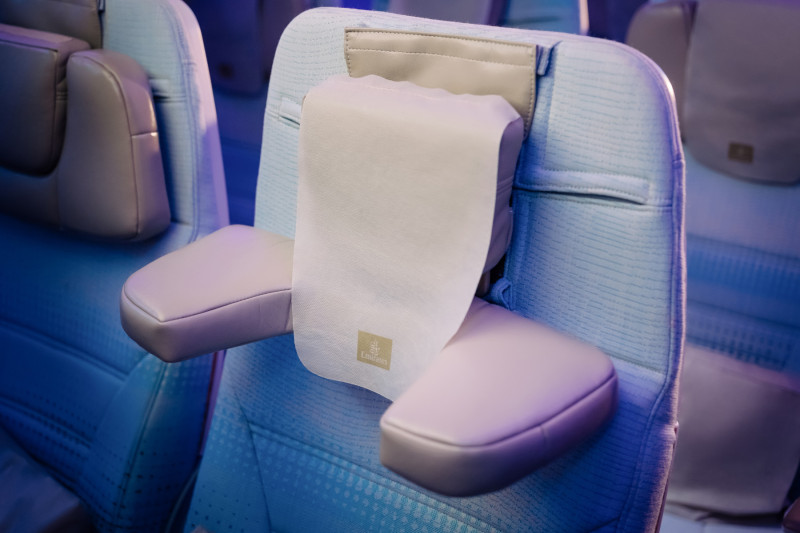
Emirates has taken a different approach with its U-Dream headrest. The airline describes it as a ‘world first’ and has started installing it across its A350 fleet. Retrofitted A380s and Boeing 777s will follow from 2027.
The padded leather headrest has folding side wings designed to support your neck and stop your head falling sideways while you sleep. Emirates president Sir Tim Clark claims passengers will no longer need to bring a neck pillow.
Emirates U-Dream bespoke economy class headrest
The marketing is excessive, but the underlying improvement is useful. Emirates fits the headrest to the standard seat and doesn’t charge passengers separately to use it. That makes it a proper economy cabin improvement, even if ‘a better headrest’ sounds less exciting than the launch campaign suggests.
Emirates has improved the seat every passenger receives. Air New Zealand has created an optional product that makes an economy flight more comfortable for passengers willing to pay again.
Why economy class innovation has become fashionable
Airlines spent much of the past decade competing at the front of the aircraft. Business class gained closing doors, larger screens and more elaborate suites. First class cabins became increasingly private and increasingly absurd.
The differences between the best premium cabins have since narrowed. Most major long-haul airlines now offer direct aisle access and lie-flat beds in business class, while the most extravagant first class products serve a very small market.
Economy gives airlines more room to create products they can market to a much larger group of passengers. However, many of these ideas don’t improve the basic economy fare. They divide the cabin into more price points.
United’s planned Relax Row is a good example. It converts three economy seats into a lie-flat couch and will begin appearing in 2027. United plans to install it on more than 200 Boeing 787s and 777s by 2030.
On its new Airbus A321XLR, United is also introducing an Economy Plus row with a fixed shared table covering the empty middle seat. Passengers receive three additional inches of legroom, but the product still sits within the economy cabin and costs more than a standard seat.
These aren’t premium economy products. They use economy seats and remain inside the economy cabin, but package additional room or comfort as paid upgrades.
That model gives airlines a new source of ancillary revenue – extra income charged on top of the ticket price. Passengers who can’t justify premium economy or business class can pay a smaller amount to make economy more tolerable.
Airlines have tried many of these ideas before
Several of these products borrow heavily from earlier designs. Air New Zealand introduced the Skycouch in 2011. Passengers can convert a row of three economy seats into a couch or flat surface. United has licensed Air New Zealand’s patent rather than developing an entirely separate concept.
Air New Zealand Skycouch promotional imagery
ANA also offers its Couchii product, while Lufthansa sells Sleeper’s Row packages on selected flights. The airline blocks a row of seats and provides a mattress topper, pillow and blanket. While some promotional imagery features an adult couple spooning, we expect (and hope) most won’t use a 3-seat bed that way! Elsewhere it appears more targeted to families with small children.
The concept isn’t new. More airlines are now trying to turn unused or specially configured economy seats into separately priced products. United can reasonably describe Relax Row as a North American first. It can’t claim to have invented the economy couch.
United Airlines Relax Row
Premium economy is a separate cabin
Premium economy often appears in discussions about economy class innovation, but it’s a distinct cabin rather than an upgraded economy seat.
A proper premium economy product normally includes a wider seat, greater recline, more legroom and improved service. Airlines price and market it as a separate travel class. Products such as Skynest, Skycouch and Relax Row work differently. Passengers remain booked in economy and pay for an additional facility, more seats or a particular row.
Airlines can also expand premium economy by reducing the size of the standard economy cabin. Delta, for example, is adding more premium economy seats to some aircraft while removing economy seats.
That may improve the aircraft’s overall premium proposition, but it doesn’t represent better economy class. In some cases, the remaining economy cabin becomes smaller or denser while more floor area goes to passengers paying higher fares.
Is upgraded economy worth paying for?
Some of these products offer real value.
A NZ$495 Skynest session on an ultra-long-haul flight could cost far less than upgrading to business class. Four hours of proper sleep may also make a considerable difference when you land.
A Skycouch or Relax Row could work well for couples and families, particularly when the alternative involves trying to sleep upright with a child spread across two seats.
Extra-legroom economy can also justify its price on the right route. We found Aegean’s Economy ComfortFlex worth the extra on the London to Athens route, although the value depends heavily on the flight length and the price difference.
Emirates’ U-Dream headrest asks nothing extra from the passenger, so there’s little downside. It’s simply a modest improvement to the standard seat.
Airlines still tend to present paid comfort options as evidence that economy itself is improving. A bunk, couch or empty middle seat may make your flight considerably better, but only after you’ve paid more than the advertised economy fare.
That isn’t necessarily poor value. It is, however, another paywall.
The best economy class innovation should improve the seat included with the ticket. Better padding, useful head support, sensible legroom and less intrusive seat hardware would benefit every passenger.
Instead, airlines increasingly offer a basic economy seat and then sell several ways to escape its limitations. The products may be clever, and some are worth buying. Just don’t confuse a more comfortable economy upgrade with an improvement to economy class itself.


Air New Zealand has started selling bunk beds to economy passengers. Its Skynest contains six full-length berths on the airline’s newest Boeing 787-9s, stacked three high on either side like a particularly polished hostel dorm.
Economy and premium economy passengers can pay NZ$495, roughly £220, for a four-hour session on routes including Auckland to New York. The first Skynest-equipped flights, originally pencilled in for November, are now due to begin on 24 December after Dreamliner delivery delays.
A proper bed available to someone travelling in economy is one of the more interesting cabin developments we’ve seen in years. However, it also reveals where much of today’s economy class innovation is heading. Airlines aren’t necessarily making the standard seat better. Instead, they’re creating new ways for economy passengers to pay for relief from it.
The pods sit between the economy and premium economy cabins. Each berth occupies roughly the floor area of an economy seat, so the airline gives up room it could otherwise fill with paying passengers.
You book Skynest for part of the flight rather than the entire trip. Passengers can’t use the bunks during take-off or landing, and cabin crew remake them between sessions. On an 18-hour flight, £220 for four hours lying flat could still represent excellent value, particularly compared with the cost of business class.
Skynest isn’t premium economy, despite premium economy passengers also having access to it. It’s a separately priced facility available to passengers travelling in either cabin.
Emirates improves the standard economy seat
Emirates has taken a different approach with its U-Dream headrest. The airline describes it as a ‘world first’ and has started installing it across its A350 fleet. Retrofitted A380s and Boeing 777s will follow from 2027.
The padded leather headrest has folding side wings designed to support your neck and stop your head falling sideways while you sleep. Emirates president Sir Tim Clark claims passengers will no longer need to bring a neck pillow.
The marketing is excessive, but the underlying improvement is useful. Emirates fits the headrest to the standard seat and doesn’t charge passengers separately to use it. That makes it a proper economy cabin improvement, even if ‘a better headrest’ sounds less exciting than the launch campaign suggests.
Emirates has improved the seat every passenger receives. Air New Zealand has created an optional product that makes an economy flight more comfortable for passengers willing to pay again.
Why economy class innovation has become fashionable
Airlines spent much of the past decade competing at the front of the aircraft. Business class gained closing doors, larger screens and more elaborate suites. First class cabins became increasingly private and increasingly absurd.
The differences between the best premium cabins have since narrowed. Most major long-haul airlines now offer direct aisle access and lie-flat beds in business class, while the most extravagant first class products serve a very small market.
Economy gives airlines more room to create products they can market to a much larger group of passengers. However, many of these ideas don’t improve the basic economy fare. They divide the cabin into more price points.
United’s planned Relax Row is a good example. It converts three economy seats into a lie-flat couch and will begin appearing in 2027. United plans to install it on more than 200 Boeing 787s and 777s by 2030.
On its new Airbus A321XLR, United is also introducing an Economy Plus row with a fixed shared table covering the empty middle seat. Passengers receive three additional inches of legroom, but the product still sits within the economy cabin and costs more than a standard seat.
These aren’t premium economy products. They use economy seats and remain inside the economy cabin, but package additional room or comfort as paid upgrades.
That model gives airlines a new source of ancillary revenue – extra income charged on top of the ticket price. Passengers who can’t justify premium economy or business class can pay a smaller amount to make economy more tolerable.
Airlines have tried many of these ideas before
Several of these products borrow heavily from earlier designs. Air New Zealand introduced the Skycouch in 2011. Passengers can convert a row of three economy seats into a couch or flat surface. United has licensed Air New Zealand’s patent rather than developing an entirely separate concept.
ANA also offers its Couchii product, while Lufthansa sells Sleeper’s Row packages on selected flights. The airline blocks a row of seats and provides a mattress topper, pillow and blanket. While some promotional imagery features an adult couple spooning, we expect (and hope) most won’t use a 3-seat bed that way! Elsewhere it appears more targeted to families with small children.
The concept isn’t new. More airlines are now trying to turn unused or specially configured economy seats into separately priced products. United can reasonably describe Relax Row as a North American first. It can’t claim to have invented the economy couch.
Premium economy is a separate cabin
Premium economy often appears in discussions about economy class innovation, but it’s a distinct cabin rather than an upgraded economy seat.
A proper premium economy product normally includes a wider seat, greater recline, more legroom and improved service. Airlines price and market it as a separate travel class. Products such as Skynest, Skycouch and Relax Row work differently. Passengers remain booked in economy and pay for an additional facility, more seats or a particular row.
Airlines can also expand premium economy by reducing the size of the standard economy cabin. Delta, for example, is adding more premium economy seats to some aircraft while removing economy seats.
That may improve the aircraft’s overall premium proposition, but it doesn’t represent better economy class. In some cases, the remaining economy cabin becomes smaller or denser while more floor area goes to passengers paying higher fares.
Is upgraded economy worth paying for?
Some of these products offer real value.
A NZ$495 Skynest session on an ultra-long-haul flight could cost far less than upgrading to business class. Four hours of proper sleep may also make a considerable difference when you land.
A Skycouch or Relax Row could work well for couples and families, particularly when the alternative involves trying to sleep upright with a child spread across two seats.
Extra-legroom economy can also justify its price on the right route. We found Aegean’s Economy ComfortFlex worth the extra on the London to Athens route, although the value depends heavily on the flight length and the price difference.
Emirates’ U-Dream headrest asks nothing extra from the passenger, so there’s little downside. It’s simply a modest improvement to the standard seat.
Airlines still tend to present paid comfort options as evidence that economy itself is improving. A bunk, couch or empty middle seat may make your flight considerably better, but only after you’ve paid more than the advertised economy fare.
That isn’t necessarily poor value. It is, however, another paywall.
The best economy class innovation should improve the seat included with the ticket. Better padding, useful head support, sensible legroom and less intrusive seat hardware would benefit every passenger.
Instead, airlines increasingly offer a basic economy seat and then sell several ways to escape its limitations. The products may be clever, and some are worth buying. Just don’t confuse a more comfortable economy upgrade with an improvement to economy class itself.
Give us a follow on TikTok and Instagram.
Related Articles
Singapore Airlines’ New Amenity Kits (but don’t mention the new seats)
British Airways promises a new era of luxury. Can it actually deliver?
Etihad A330neo Business Class Arrives Amid continuing regional uncertainty
British Airways New A380 First Class Hides 88 Missing Economy Seats