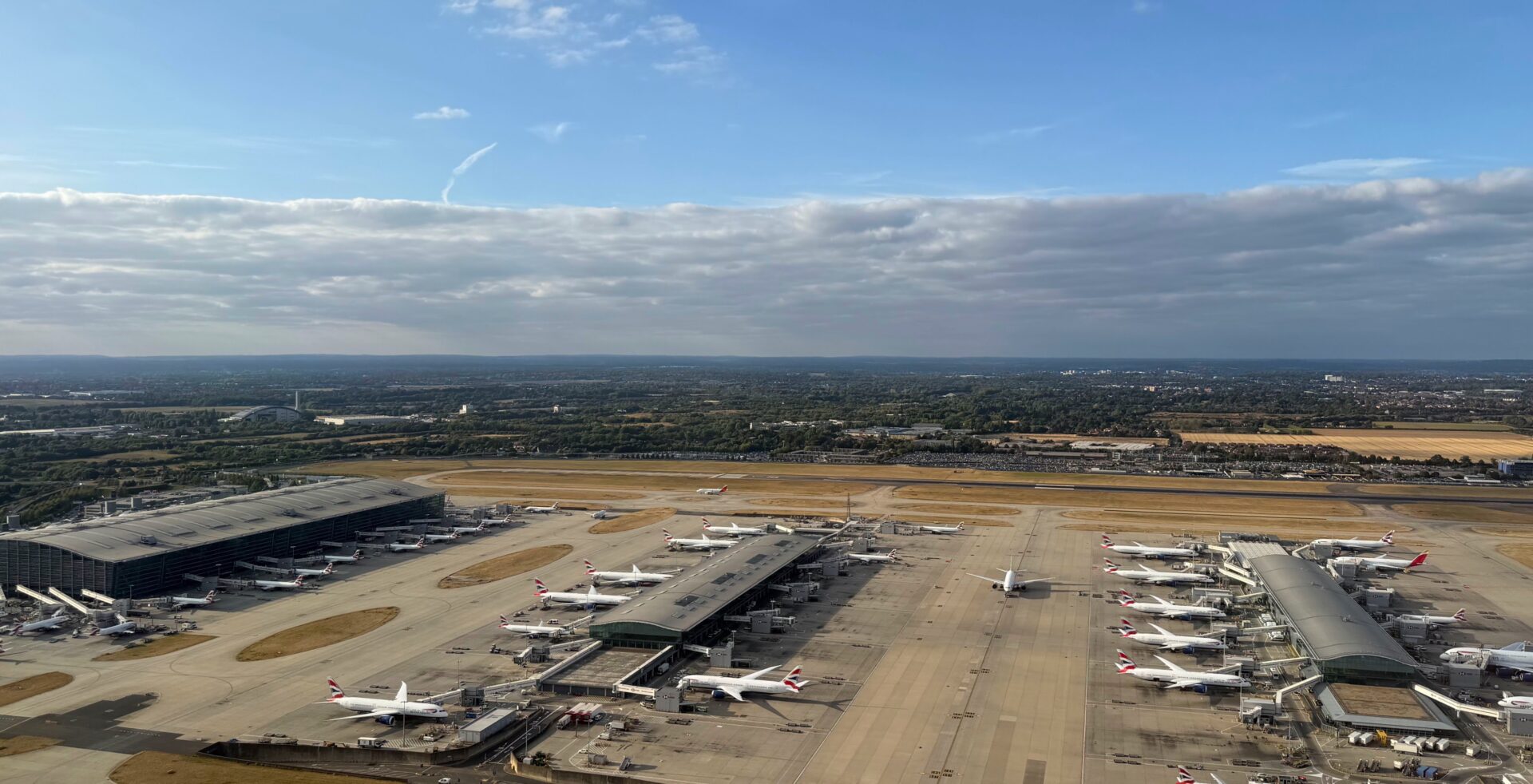
There’s a word doing enormous work in the case for a Heathrow third runway, and it makes us twitch every time we hear it: ‘futureproof’.
It sounds sensible. Nobody wants to spend billions on something that goes obsolete in five years. But going ‘futureproof’ is also a very expensive way of solving problems that don’t exist yet, might never exist, and sometimes turn out to be the exact opposite of what happens.
Which brings us to a phrase buried in the government’s draft planning policy that almost nobody has picked up on.
The Policy Says ‘Up To’, Not ‘At Least’
The consultation on the draft Heathrow Expansion National Policy Statement closed on 1 September. The HENPS is the rulebook: it sets out what any expansion scheme has to prove before it can apply for planning consent. Ministers want it signed off by the end of 2026, after a Commons vote and scrutiny from the Transport Committee.
Read the scope and you find something odd. The policy covers a northwest runway “having a runway length up to 3,500m” as part of a scheme that can deliver at least 260,000 extra air transport movements a year. Air transport movements, or ATMs, are simply take-offs and landings.
So the binding number isn’t the runway length at all. It’s the flights.
Heidi Alexander said as much when she launched the consultation, describing the up-to-3,500m allowance as something that makes the scheme more flexible on timing and cost. Heathrow itself submitted plans for a full-length runway while saying it remained open to a shorter one.
Everyone has left themselves room to manoeuvre. Which is worth knowing, because the public argument has been running as though 3,500m is settled.
Illustration of the Heathrow third runway ‘futureproof’ proposal across the M25 motorway
The mental picture of Heathrow doesn’t match what actually uses it.
Analysis submitted with the rival Heathrow West bid counted 240,064 departures in 2024. Of those, 147,117 were narrow-body aircraft, or 61.3% of the total. Wide-bodies made up the other 38.7%.
Even ‘wide-body’ tells you less than you’d think. A 777 leaving for Singapore with full tanks is a different animal from a 787 popping over to New York with far less fuel aboard. Runway length depends on weight, weather and destination, not on how many aisles the cabin has.
IAG commissioned modelling of a 2,800m runway using real aircraft types, routes and operating weights. It found that length could take every narrow-body departure and 89% of wide-body departures. Add arrivals and the figure came out at 97.8% of all movements.
Two caveats, and they’re big ones. IAG has backed the rival bid since 2017, so this is analysis produced by an interested party. And Arora has since changed its own proposal, which we’ll come to.
A Heathrow Third Runway Doesn’t Replace The Other Two
This point is so obvious it keeps getting lost.
Heathrow’s northern runway is 3,902m long and its southern runway is 3,658m, according to the airport’s own figures. Neither is going anywhere. A third runway doesn’t replace them, it joins them.
So send the A320 bound for Amsterdam to the new strip. Send the 787 heading for Boston there too. When a fully loaded long-haul departure needs more tarmac, put it on one of the other two. The same modelling calculated that only about 0.7% of take-offs would need switching for distance reasons.
Even the government’s own assessment accepted the operational logic. It preferred Heathrow Airport Limited’s scheme, but found the two arrangements broadly comparable when judged as complete three-runway airports.
That reframes the question. It’s no longer whether 3,500m beats 2,800m, because of course it does. Give us unlimited money and we’d have three 5,000m runways, six terminals and a private immigration lane for BoardingGroup.One readers. The useful question is what we’re paying for that last slice of capability.
Here’s where the debate has moved on, and where a lot of commentary hasn’t caught up.
In May 2026, Arora’s Heathrow West team published a revised scheme built with Bechtel. It’s now two phases. Phase one delivers a 2,400m runway by 2035, designed to be extended later while staying in use during the work. A new Terminal 6 sits west of Terminal 5.
The pitch is risk reduction rather than penny-pinching. A shorter first runway avoids moving the M25 and the other high-risk works, so capacity arrives sooner and cheaper. Arora intends to submit a development consent order application, the formal planning bid, in November 2027 whatever the government’s preference.
But 2,400m is not 2,800m, and the IAG modelling doesn’t cover it. Anyone citing the 97.8% figure in support of the current Heathrow West scheme is quoting the wrong runway. We’d like to see that analysis redone and published before the Commons votes.
This also isn’t quite a dead campaign. The CAA published its final decision on 29 July, allowing Heathrow West to recover about £4.14 million of costs incurred before the government picked Heathrow’s scheme. Heathrow itself stays capped at £320 million. More tellingly, the regulator says its next round of work will look at Heathrow West’s 2026 costs for progressing its own DCO application. Arora is still spending money on getting this thing built, and the regulator is still deciding how that spending should be treated.
Worth noticing who pays. The CAA reckons early cost recovery alone adds around 15 pence to the maximum charge per passenger from 2028, rising to an estimated 30 pence after that.
Heathrow West proposed site plan
Heathrow’s Case Is Better Than Its Critics Allow
We should be fair here, because the airport has real arguments and they rarely get aired properly.
The third ‘futureproof’ runway at Heathrow and its supporting airfield would take the largest Code F aircraft, including the A380. Code F is a dimensional category, covering wingspan and the runway width, shoulders and taxiway clearances needed to handle it. It says nothing about how much tarmac a given departure needs on a given day.
The length argument is separate, and it’s a decent one. The full 3,500m leaves controllers with far fewer restrictions on which departures can use which runway, which means three interchangeable runways rather than two-and-a-bit. When one closes for a burst tyre or a diversion, that interchangeability is what stops the whole airfield seizing up.
It also underpins runway alternation, the system that swaps which runway handles landings partway through the day so people underneath get predictable quiet periods. Heathrow argues you can only extend that properly to a third runway if all three can take the same traffic.
Then there’s deliverability. The government judged Heathrow’s scheme the most mature and most likely to reach a consent decision this Parliament, and it needs fewer homes than the Heathrow West footprint. Since Heathrow expansion has now been argued about for the better part of 20 years, ‘we can actually build this one’ carries weight.
And if the aircraft of 2050 do want 4,000m, Heathrow will look very clever indeed.
Remember When The A380 Was The Future?
Our problem isn’t the resilience case. It’s the ‘futureproof’ case, which the government explicitly cited when picking the longer runway.
Futureproofing against what, exactly?
The A380 was once the obvious answer to congested hubs. Move more people per slot by building a bigger aeroplane. It made complete sense at the time. Then the market went elsewhere, and Airbus wound up the line with the last delivery in December 2021. Even Emirates trimmed its final order while buying smaller A330neos and A350s. We’ve written before about how the A380 became a plane British Airways struggles to justify refitting.
A380 Etihad on the ground
Meanwhile Airbus built the A321XLR, a descendant of the same narrow-body family that shuttles around Europe, and gave it a range of up to 4,700 nautical miles. Airbus markets it squarely at thin long-haul routes that used to need a wide-body. We’ve flown the shorter A321 on business class runs that would have been an absurd use of a 777 a decade ago.
None of this proves aircraft are shrinking. The 777-9 is enormous and Emirates hasn’t turned its A380s into plant pots. But it does show how badly the industry read its own future 20 years ago, which is roughly the horizon we’re being asked to buy insurance against now.
Concrete Isn’t The Only Way To Add Capacity
Runway length is one variable. How closely you can pack aircraft onto a runway is another, and that’s moving.
Wake turbulence separation is the gap controllers must leave so a following aircraft doesn’t fly through the swirling air left by the one ahead. EUROCONTROL’s pair-wise scheme sets those gaps by specific aircraft pairing rather than crude weight bands. For frequent pairings it cuts spacing by 0.5 or 1 nautical mile, or up to 30 seconds on departure. The UK CAA published its opinion on the safety case in October 2024.
The effect is real, not theoretical. Paris Charles de Gaulle picked up two to four extra movements an hour at peak from the earlier version of the same work.
Now imagine where surveillance, automated sequencing and wake prediction land by the time a ‘futureproof’ Heathrow third runway has been open for 30 years. We don’t know. That’s precisely the point, and it cuts against the long runway as much as it cuts for it.
What We’d Actually Want To See
We’re not against Heathrow expansion. We’re also not convinced Arora has solved every problem Heathrow hasn’t, and the phased scheme brings its own headache: building an extension later, next to a live runway, is not free.
What we object to is ‘futureproofing’ being treated as an argument that ends the discussion rather than one that starts it.
Good engineering isn’t about designing for every imaginable requirement. It’s about deciding which requirements earn their cost. One question has saved us more money over the years than any other. We spent two decades in software before we started writing about travel, and the project we still think about was a database sized for 10 times the traffic anyone expected, because a director wanted headroom. It was switched off six years later, still running at 8% of capacity. Nobody was ever pulled up for it, because you can’t prove a disaster you prevented.
The question is simply: what requirement are we actually solving?
Right now 61% of Heathrow departures are narrow-bodies, the airport already has two runways longer than 3,500m, and the industry that once bet on the A380 now sells single-aisle jets that fly for 11 hours. The longer Heathrow scheme also comes packaged with one of the project’s biggest engineering headaches: realigning and lowering part of the M25 beneath the new runway. Arora’s shorter first phase avoids that work altogether. The tunnel is costed at £1.5 billion, inside a runway and airfield budget of £21 billion that has grown from £14 billion in 2018 on construction inflation, with the wider programme at £49 billion.
We’ve watched enough megaprojects to know how that curve tends to bend. Berlin Brandenburg cost seven billion euros and opened nine years late.
The government consultation closed on 1 September, so that route has gone. The Transport Committee is now the live arena, and it’s the more interesting one anyway.
Its written evidence deadline passed on 23 July, and it published more than 70 submissions on 14 August. Oral evidence sessions began this month. The committee reports before the Commons votes, with designation intended by the end of 2026.
Those submissions are worth reading. IAG told the committee that the £49 billion price tag isn’t just large but exceptional, that it far exceeds Amsterdam, Paris, Frankfurt and Istanbul, and that Heathrow’s cost evidence is selective, inconsistent and not robust enough to underpin a commitment this size. Airlines also flagged that Heathrow wants £320 million for early planning across 2025 and 2026, while Arora spent between £3.5 million and £4 million doing the same job.
Perhaps the aircraft of 2050 will need longer runways. Perhaps they’ll need shorter ones. Or better sequencing squeezes far more out of each runway than anyone designing this airport today expects.
Nobody knows which future they’re proofing against, and passengers pay the premium either way. So watch IAG when it appears before the committee. If anyone should have to defend that 97.8% modelling under questioning, it’s the airline group that commissioned it.


There’s a word doing enormous work in the case for a Heathrow third runway, and it makes us twitch every time we hear it: ‘futureproof’.
It sounds sensible. Nobody wants to spend billions on something that goes obsolete in five years. But going ‘futureproof’ is also a very expensive way of solving problems that don’t exist yet, might never exist, and sometimes turn out to be the exact opposite of what happens.
Which brings us to a phrase buried in the government’s draft planning policy that almost nobody has picked up on.
The Policy Says ‘Up To’, Not ‘At Least’
The consultation on the draft Heathrow Expansion National Policy Statement closed on 1 September. The HENPS is the rulebook: it sets out what any expansion scheme has to prove before it can apply for planning consent. Ministers want it signed off by the end of 2026, after a Commons vote and scrutiny from the Transport Committee.
Read the scope and you find something odd. The policy covers a northwest runway “having a runway length up to 3,500m” as part of a scheme that can deliver at least 260,000 extra air transport movements a year. Air transport movements, or ATMs, are simply take-offs and landings.
So the binding number isn’t the runway length at all. It’s the flights.
Heidi Alexander said as much when she launched the consultation, describing the up-to-3,500m allowance as something that makes the scheme more flexible on timing and cost. Heathrow itself submitted plans for a full-length runway while saying it remained open to a shorter one.
Everyone has left themselves room to manoeuvre. Which is worth knowing, because the public argument has been running as though 3,500m is settled.
Read: Will Heathrow Ever Expand? The Runway That Refuses to Take Off
Most Heathrow Departures Aren’t Heavy Wide-Bodies
The mental picture of Heathrow doesn’t match what actually uses it.
Analysis submitted with the rival Heathrow West bid counted 240,064 departures in 2024. Of those, 147,117 were narrow-body aircraft, or 61.3% of the total. Wide-bodies made up the other 38.7%.
Even ‘wide-body’ tells you less than you’d think. A 777 leaving for Singapore with full tanks is a different animal from a 787 popping over to New York with far less fuel aboard. Runway length depends on weight, weather and destination, not on how many aisles the cabin has.
IAG commissioned modelling of a 2,800m runway using real aircraft types, routes and operating weights. It found that length could take every narrow-body departure and 89% of wide-body departures. Add arrivals and the figure came out at 97.8% of all movements.
Two caveats, and they’re big ones. IAG has backed the rival bid since 2017, so this is analysis produced by an interested party. And Arora has since changed its own proposal, which we’ll come to.
A Heathrow Third Runway Doesn’t Replace The Other Two
This point is so obvious it keeps getting lost.
Heathrow’s northern runway is 3,902m long and its southern runway is 3,658m, according to the airport’s own figures. Neither is going anywhere. A third runway doesn’t replace them, it joins them.
So send the A320 bound for Amsterdam to the new strip. Send the 787 heading for Boston there too. When a fully loaded long-haul departure needs more tarmac, put it on one of the other two. The same modelling calculated that only about 0.7% of take-offs would need switching for distance reasons.
Even the government’s own assessment accepted the operational logic. It preferred Heathrow Airport Limited’s scheme, but found the two arrangements broadly comparable when judged as complete three-runway airports.
That reframes the question. It’s no longer whether 3,500m beats 2,800m, because of course it does. Give us unlimited money and we’d have three 5,000m runways, six terminals and a private immigration lane for BoardingGroup.One readers. The useful question is what we’re paying for that last slice of capability.
Read: Heathrow’s Terminal 5 Transit Doubles Its Capacity
Arora Has Already Changed Its Answer
Here’s where the debate has moved on, and where a lot of commentary hasn’t caught up.
In May 2026, Arora’s Heathrow West team published a revised scheme built with Bechtel. It’s now two phases. Phase one delivers a 2,400m runway by 2035, designed to be extended later while staying in use during the work. A new Terminal 6 sits west of Terminal 5.
The pitch is risk reduction rather than penny-pinching. A shorter first runway avoids moving the M25 and the other high-risk works, so capacity arrives sooner and cheaper. Arora intends to submit a development consent order application, the formal planning bid, in November 2027 whatever the government’s preference.
But 2,400m is not 2,800m, and the IAG modelling doesn’t cover it. Anyone citing the 97.8% figure in support of the current Heathrow West scheme is quoting the wrong runway. We’d like to see that analysis redone and published before the Commons votes.
This also isn’t quite a dead campaign. The CAA published its final decision on 29 July, allowing Heathrow West to recover about £4.14 million of costs incurred before the government picked Heathrow’s scheme. Heathrow itself stays capped at £320 million. More tellingly, the regulator says its next round of work will look at Heathrow West’s 2026 costs for progressing its own DCO application. Arora is still spending money on getting this thing built, and the regulator is still deciding how that spending should be treated.
Worth noticing who pays. The CAA reckons early cost recovery alone adds around 15 pence to the maximum charge per passenger from 2028, rising to an estimated 30 pence after that.
Heathrow’s Case Is Better Than Its Critics Allow
We should be fair here, because the airport has real arguments and they rarely get aired properly.
The third ‘futureproof’ runway at Heathrow and its supporting airfield would take the largest Code F aircraft, including the A380. Code F is a dimensional category, covering wingspan and the runway width, shoulders and taxiway clearances needed to handle it. It says nothing about how much tarmac a given departure needs on a given day.
The length argument is separate, and it’s a decent one. The full 3,500m leaves controllers with far fewer restrictions on which departures can use which runway, which means three interchangeable runways rather than two-and-a-bit. When one closes for a burst tyre or a diversion, that interchangeability is what stops the whole airfield seizing up.
It also underpins runway alternation, the system that swaps which runway handles landings partway through the day so people underneath get predictable quiet periods. Heathrow argues you can only extend that properly to a third runway if all three can take the same traffic.
Then there’s deliverability. The government judged Heathrow’s scheme the most mature and most likely to reach a consent decision this Parliament, and it needs fewer homes than the Heathrow West footprint. Since Heathrow expansion has now been argued about for the better part of 20 years, ‘we can actually build this one’ carries weight.
And if the aircraft of 2050 do want 4,000m, Heathrow will look very clever indeed.
Remember When The A380 Was The Future?
Our problem isn’t the resilience case. It’s the ‘futureproof’ case, which the government explicitly cited when picking the longer runway.
Futureproofing against what, exactly?
The A380 was once the obvious answer to congested hubs. Move more people per slot by building a bigger aeroplane. It made complete sense at the time. Then the market went elsewhere, and Airbus wound up the line with the last delivery in December 2021. Even Emirates trimmed its final order while buying smaller A330neos and A350s. We’ve written before about how the A380 became a plane British Airways struggles to justify refitting.
Meanwhile Airbus built the A321XLR, a descendant of the same narrow-body family that shuttles around Europe, and gave it a range of up to 4,700 nautical miles. Airbus markets it squarely at thin long-haul routes that used to need a wide-body. We’ve flown the shorter A321 on business class runs that would have been an absurd use of a 777 a decade ago.
None of this proves aircraft are shrinking. The 777-9 is enormous and Emirates hasn’t turned its A380s into plant pots. But it does show how badly the industry read its own future 20 years ago, which is roughly the horizon we’re being asked to buy insurance against now.
Concrete Isn’t The Only Way To Add Capacity
Runway length is one variable. How closely you can pack aircraft onto a runway is another, and that’s moving.
Wake turbulence separation is the gap controllers must leave so a following aircraft doesn’t fly through the swirling air left by the one ahead. EUROCONTROL’s pair-wise scheme sets those gaps by specific aircraft pairing rather than crude weight bands. For frequent pairings it cuts spacing by 0.5 or 1 nautical mile, or up to 30 seconds on departure. The UK CAA published its opinion on the safety case in October 2024.
The effect is real, not theoretical. Paris Charles de Gaulle picked up two to four extra movements an hour at peak from the earlier version of the same work.
Now imagine where surveillance, automated sequencing and wake prediction land by the time a ‘futureproof’ Heathrow third runway has been open for 30 years. We don’t know. That’s precisely the point, and it cuts against the long runway as much as it cuts for it.
What We’d Actually Want To See
We’re not against Heathrow expansion. We’re also not convinced Arora has solved every problem Heathrow hasn’t, and the phased scheme brings its own headache: building an extension later, next to a live runway, is not free.
What we object to is ‘futureproofing’ being treated as an argument that ends the discussion rather than one that starts it.
Good engineering isn’t about designing for every imaginable requirement. It’s about deciding which requirements earn their cost. One question has saved us more money over the years than any other. We spent two decades in software before we started writing about travel, and the project we still think about was a database sized for 10 times the traffic anyone expected, because a director wanted headroom. It was switched off six years later, still running at 8% of capacity. Nobody was ever pulled up for it, because you can’t prove a disaster you prevented.
The question is simply: what requirement are we actually solving?
Right now 61% of Heathrow departures are narrow-bodies, the airport already has two runways longer than 3,500m, and the industry that once bet on the A380 now sells single-aisle jets that fly for 11 hours. The longer Heathrow scheme also comes packaged with one of the project’s biggest engineering headaches: realigning and lowering part of the M25 beneath the new runway. Arora’s shorter first phase avoids that work altogether. The tunnel is costed at £1.5 billion, inside a runway and airfield budget of £21 billion that has grown from £14 billion in 2018 on construction inflation, with the wider programme at £49 billion.
We’ve watched enough megaprojects to know how that curve tends to bend. Berlin Brandenburg cost seven billion euros and opened nine years late.
Read: Heathrow Fast Track Arrivals: Is It Worth £35?
What Happens Next
The government consultation closed on 1 September, so that route has gone. The Transport Committee is now the live arena, and it’s the more interesting one anyway.
Its written evidence deadline passed on 23 July, and it published more than 70 submissions on 14 August. Oral evidence sessions began this month. The committee reports before the Commons votes, with designation intended by the end of 2026.
Those submissions are worth reading. IAG told the committee that the £49 billion price tag isn’t just large but exceptional, that it far exceeds Amsterdam, Paris, Frankfurt and Istanbul, and that Heathrow’s cost evidence is selective, inconsistent and not robust enough to underpin a commitment this size. Airlines also flagged that Heathrow wants £320 million for early planning across 2025 and 2026, while Arora spent between £3.5 million and £4 million doing the same job.
Perhaps the aircraft of 2050 will need longer runways. Perhaps they’ll need shorter ones. Or better sequencing squeezes far more out of each runway than anyone designing this airport today expects.
Nobody knows which future they’re proofing against, and passengers pay the premium either way. So watch IAG when it appears before the committee. If anyone should have to defend that 97.8% modelling under questioning, it’s the airline group that commissioned it.
Give us a follow on TikTok and Instagram. Check out our videos on the BoardingGroup.One YouTube channel.
Related Articles
Singapore Airlines’ New Amenity Kits (but don’t mention the new seats)
British Airways promises a new era of luxury. Can it actually deliver?
Etihad A330neo Business Class Arrives Amid continuing regional uncertainty
British Airways New A380 First Class Hides 88 Missing Economy Seats