Etihad has shown off the cabins heading onto its incoming A330-900neos, and the Etihad A330neo business class seat is the headline: 24 forward-facing lie-flat beds, all with direct aisle access. Above it sit four First suites. Below it, 252 economy seats. On paper it is a tidy, unremarkable three-cabin layout of the sort Gulf carriers produce every couple of years.
What makes it worth a second look is the timing. Only months ago this was an airline flying a fraction of its normal schedule while missiles crossed its home region. We have flown Etihad through two of these seat generations now, and while the hardware interests us, the decision behind it is just as intriguing.
Why Cabin Reveals Usually Mean Nothing
We read most of these announcements as scoreboard updates. Emirates does something, Qatar answers, Etihad answers back, and none of it seems to connect to the outside world. Fleet planning runs on five-year cycles, and seats get signed off long before anyone knows what the geopolitical situation will look like when they arrive.
However, capital commitments can be deferred, trimmed or abandoned, and plenty of airlines did exactly that when conditions turned. Etihad did not.
Render of Etihad’s upcoming A330neo aircraft
What the Gulf Hubs Actually Risk
Gulf carriers live or die on sixth-freedom traffic – passengers travelling between two foreign countries via the airline’s home hub. Think London to Bangkok via Doha, or Paris to Sydney via Dubai. That model works brilliantly until the hub itself becomes unsafe. Then the entire network stops at once.
So when the late February air strikes began, flight numbers across Emirates, Etihad, flydubai, Qatar Airways and Air Arabia fell close to zero within days. Etihad bottomed out around 15% of pre-conflict levels. Recovery was uneven, too. Cirium schedule data from April had Emirates operating at near three-quarters of its normal capacity, with Etihad and Air Arabia around half and Qatar Airways trailing at roughly 20%.
IATA’s June outlook turned a projected $7.2bn net profit for Middle East carriers in 2025 into a forecast $4.3bn loss for 2026. That is the sort of swing that usually ends with press releases about reviewing the order book. Etihad went the other way.
The Etihad A330neo Business Class Case for Confidence
Against that backdrop, the specification reads differently. Each First suite gets a closing door, a 32-inch screen, wireless charging, dedicated storage and a personal powder station, plus room to dine with a companion. Each business seat has a sliding door, a 17.3-inch screen, wired and wireless charging, a proper table and its own storage.
Fifteen A330-900neos are on order, with deliveries running from late 2027 through 2032, aimed at regional and medium-haul flying. Etihad places the cabins inside a $20 billion programme covering lounges, dining, amenities, wellbeing and connectivity. Etihad’s chief executive, Antonoaldo Neves, highlighted August load factor of 92% and a full-year target above 87%. Load factor is the easiest number to pump with cheap seats – we’ve seen significant increases in attractive sale fares in the last few months.
The Etihad 787 Business Class seat
Those who fly Qatar Airways enough will know there’s a downside to frequent cabin upgrades: product fragmentation. This is Etihad’s fourth distinct business class seat in about as many years: the older A380 and 787 product, the A350 seat, the retrofitted 787 cabin, and now this. The improvement and innovation is admirable, but consistency across the fleet is not Etihad’s strong suit, and passengers keep paying the same fare for quiet different products.
What This Means for Your Next Booking
We would not assume one Etihad premium cabin looks like another. From 2027, check the aircraft type before booking, because First on this fleet sits on specific airframes and the business seat will vary by generation for years yet.
We see sustained investment through instability as a positive signal. Airlines that keep buying seats tend to keep adding capacity, and capacity is what eventually loosens award space and triggers more frequent discounting. If you haven’t yet booked a £1,600 Etihad business fare out of LHR, there might still be opportunities in the near future.
Etihad tail fins on stand at Abu Dhabi Zayed International Airport
The Real Signal
The seats are good. Ordering them while the hub was half-closed tells you more. Etihad is betting that premium demand outlasts regional risk, and it is putting $20 billion behind that view rather than waiting for calmer skies.
We’ve flown the A330neo with a couple of other airlines and found it to be good in many ways – quieter, better air circulation, and lighting – so we think it’ll make a good addition to the Etihad fleet. Read Delta One Suite A330neo Atlanta to London Review and TAP A330neo Business Class Review for more details about those trips.

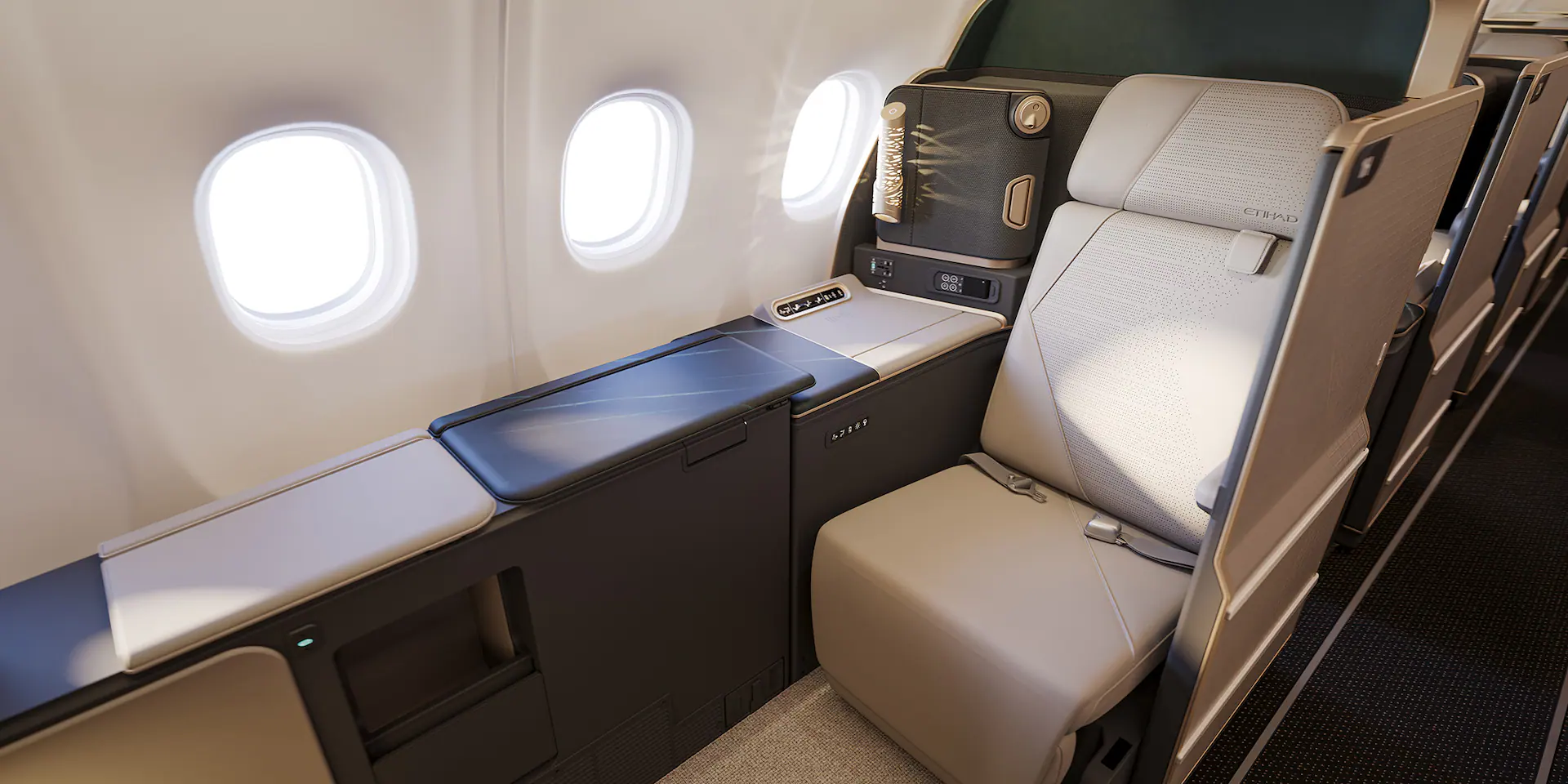

Etihad has shown off the cabins heading onto its incoming A330-900neos, and the Etihad A330neo business class seat is the headline: 24 forward-facing lie-flat beds, all with direct aisle access. Above it sit four First suites. Below it, 252 economy seats. On paper it is a tidy, unremarkable three-cabin layout of the sort Gulf carriers produce every couple of years.
What makes it worth a second look is the timing. Only months ago this was an airline flying a fraction of its normal schedule while missiles crossed its home region. We have flown Etihad through two of these seat generations now, and while the hardware interests us, the decision behind it is just as intriguing.
Why Cabin Reveals Usually Mean Nothing
We read most of these announcements as scoreboard updates. Emirates does something, Qatar answers, Etihad answers back, and none of it seems to connect to the outside world. Fleet planning runs on five-year cycles, and seats get signed off long before anyone knows what the geopolitical situation will look like when they arrive.
However, capital commitments can be deferred, trimmed or abandoned, and plenty of airlines did exactly that when conditions turned. Etihad did not.
What the Gulf Hubs Actually Risk
Gulf carriers live or die on sixth-freedom traffic – passengers travelling between two foreign countries via the airline’s home hub. Think London to Bangkok via Doha, or Paris to Sydney via Dubai. That model works brilliantly until the hub itself becomes unsafe. Then the entire network stops at once.
So when the late February air strikes began, flight numbers across Emirates, Etihad, flydubai, Qatar Airways and Air Arabia fell close to zero within days. Etihad bottomed out around 15% of pre-conflict levels. Recovery was uneven, too. Cirium schedule data from April had Emirates operating at near three-quarters of its normal capacity, with Etihad and Air Arabia around half and Qatar Airways trailing at roughly 20%.
IATA’s June outlook turned a projected $7.2bn net profit for Middle East carriers in 2025 into a forecast $4.3bn loss for 2026. That is the sort of swing that usually ends with press releases about reviewing the order book. Etihad went the other way.
The Etihad A330neo Business Class Case for Confidence
Against that backdrop, the specification reads differently. Each First suite gets a closing door, a 32-inch screen, wireless charging, dedicated storage and a personal powder station, plus room to dine with a companion. Each business seat has a sliding door, a 17.3-inch screen, wired and wireless charging, a proper table and its own storage.
Fifteen A330-900neos are on order, with deliveries running from late 2027 through 2032, aimed at regional and medium-haul flying. Etihad places the cabins inside a $20 billion programme covering lounges, dining, amenities, wellbeing and connectivity. Etihad’s chief executive, Antonoaldo Neves, highlighted August load factor of 92% and a full-year target above 87%. Load factor is the easiest number to pump with cheap seats – we’ve seen significant increases in attractive sale fares in the last few months.
Those who fly Qatar Airways enough will know there’s a downside to frequent cabin upgrades: product fragmentation. This is Etihad’s fourth distinct business class seat in about as many years: the older A380 and 787 product, the A350 seat, the retrofitted 787 cabin, and now this. The improvement and innovation is admirable, but consistency across the fleet is not Etihad’s strong suit, and passengers keep paying the same fare for quiet different products.
What This Means for Your Next Booking
We would not assume one Etihad premium cabin looks like another. From 2027, check the aircraft type before booking, because First on this fleet sits on specific airframes and the business seat will vary by generation for years yet.
Read: Etihad A380 First Class London to Abu Dhabi Review
We see sustained investment through instability as a positive signal. Airlines that keep buying seats tend to keep adding capacity, and capacity is what eventually loosens award space and triggers more frequent discounting. If you haven’t yet booked a £1,600 Etihad business fare out of LHR, there might still be opportunities in the near future.
The Real Signal
The seats are good. Ordering them while the hub was half-closed tells you more. Etihad is betting that premium demand outlasts regional risk, and it is putting $20 billion behind that view rather than waiting for calmer skies.
We’ve flown the A330neo with a couple of other airlines and found it to be good in many ways – quieter, better air circulation, and lighting – so we think it’ll make a good addition to the Etihad fleet. Read Delta One Suite A330neo Atlanta to London Review and TAP A330neo Business Class Review for more details about those trips.
Give us a follow on TikTok and Instagram.
Related Articles
British Airways New A380 First Class Hides 88 Missing Economy Seats
American Airlines Opens Flagship Dining to Business Class
Emirates Wine Cellar Onboard: Serious Investment or Great PR?
Heathrow Third Runway: Futureproof Against What?