

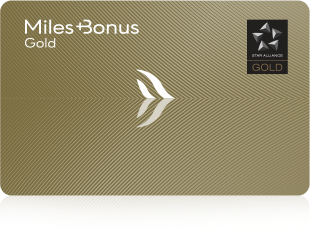
Star Alliance Gold has some wonderfully odd quirks. On a domestic United flight in the US, our Aegean Miles+Bonus Gold card got us into the United Club, while United’s own Premier Gold members travelling domestically could be turned away. The reason is simple, if slightly absurd: foreign Star Alliance Gold members get lounge access on domestic itineraries, while MileagePlus Gold members usually need same-day international Star Alliance travel. Our Greek status was more useful in a United lounge than United’s own equivalent tier.
Star Alliance Gold status is the top of a two-tier ladder, not the middle of a three-tier one. That single structural fact explains why it feels broader than its rivals. It bundles business class lounge access, fast track and an extra bag into one tier, where Oneworld splits the first two across Sapphire and Emerald.
What Star Alliance Gold status actually is
Star Alliance runs only two reciprocal tiers: Silver and Gold. Gold is the top one. You can’t join the alliance directly, so you earn status with a member airline’s own programme, and that programme maps your tier onto Silver or Gold.
The practical effect is a wider single tier. Oneworld makes you reach Emerald for fast track and settles for Sapphire on lounges, whereas Star gives Gold holders both. It stops short of Emerald’s first class lounges and first class check-in. Most member programmes grant Gold somewhere around their middle tier, which makes it more accessible than its position at the top of the ladder suggests.
| Alliance | Star Alliance |
| Tier level | Gold – Top of two |
| Member airlines | 26, dropping to 25 on 17 December 2026 |
| Lounge access | Over 1,000 lounges, one guest |
| Extra checked bag | 20kg or one extra piece |
| Fast track security | Gold Track, around 150 airports |
| Priority baggage | Yes |
| Equivalent elsewhere | Roughly Oneworld Sapphire plus Emerald-style fast track, SkyTeam Elite Plus |
Which airlines give you Star Alliance Gold status
The alliance has 26 members, and the roster is moving. ITA Airways joined on 1 April 2026, having left SkyTeam for the Lufthansa orbit. Asiana leaves at 23:59 Korea time on 16 December 2026 as it merges into Korean Air, taking the count to 25 from 17 December. SAS went the other way in 2024 and now sits in SkyTeam, so an old EuroBonus card no longer does anything here.
Here’s every member programme and the tier that grants Gold.
| Airline | Programme | Tier that grants Gold |
|---|---|---|
| Air Canada | Aeroplan | 50K, 75K and Super Elite |
| Air China | PhoenixMiles | Gold and Platinum |
| Air India | Maharaja Club | Gold and Platinum |
| Air New Zealand | Airpoints | Koru Gold, Koru Platinum and Koru Black |
| ANA | ANA Mileage Club | Platinum, Diamond and Super Flyers |
| Asiana Airlines | Asiana Club | Diamond, Diamond Plus and Platinum |
| Austrian Airlines | Miles & More | Senator and HON Circle |
| Avianca | LifeMiles | Gold and Diamond |
| Brussels Airlines | Miles & More | Senator and HON Circle |
| Copa Airlines | ConnectMiles | Gold, Platinum and Presidential Platinum |
| Croatia Airlines | Miles & More | Senator and HON Circle |
| EGYPTAIR | EGYPTAIR Plus | Gold, Elite and Platinum |
| Ethiopian Airlines | ShebaMiles | Gold and Platinum |
| EVA Air | Infinity MileageLands | Gold and Diamond |
| ITA Airways | Volare | Premium and Executive |
| LOT Polish Airlines | Miles & More | Senator and HON Circle |
| Lufthansa | Miles & More | Senator and HON Circle |
| Shenzhen Airlines | PhoenixMiles | Gold and Platinum |
| Singapore Airlines | KrisFlyer | Elite Gold, PPS Club and Solitaire PPS Club |
| South African Airways | SAA Voyager | Gold, Platinum and Lifetime Platinum |
| SWISS | Miles & More | Senator and HON Circle |
| TAP Air Portugal | Miles&Go | Gold and Platinum |
| Thai Airways | Royal Orchid Plus | Gold and Platinum |
| Turkish Airlines | Miles&Smiles | Elite and Elite Plus |
| United Airlines | MileagePlus | Premier Gold, Platinum and 1K |
What you get with Star Alliance Gold status
Here’s what Star Alliance Gold gives you:
Lounge access
Over 1,000 lounges, and your cabin is irrelevant. Fly economy on a Frankfurt hop and you still get in.
You can bring one guest. At member airline and Star Alliance lounges they need a boarding pass for any Star Alliance flight departing from the same airport, so they don’t have to be on your flight. At third-party contract lounges the test is tighter: your guest has to be flying the same airline as you.
Checked baggage
An extra 20kg on weight-based tickets, or one additional piece on piece-based ones. Which system applies depends on the operating airline’s baggage policy, not your status.
Priority check-in
You use the business class desk or a dedicated counter carrying the Star Alliance Gold sign. First class check-in isn’t part of the deal. This is still the benefit that saves the most time at busy hubs.
Fast track security
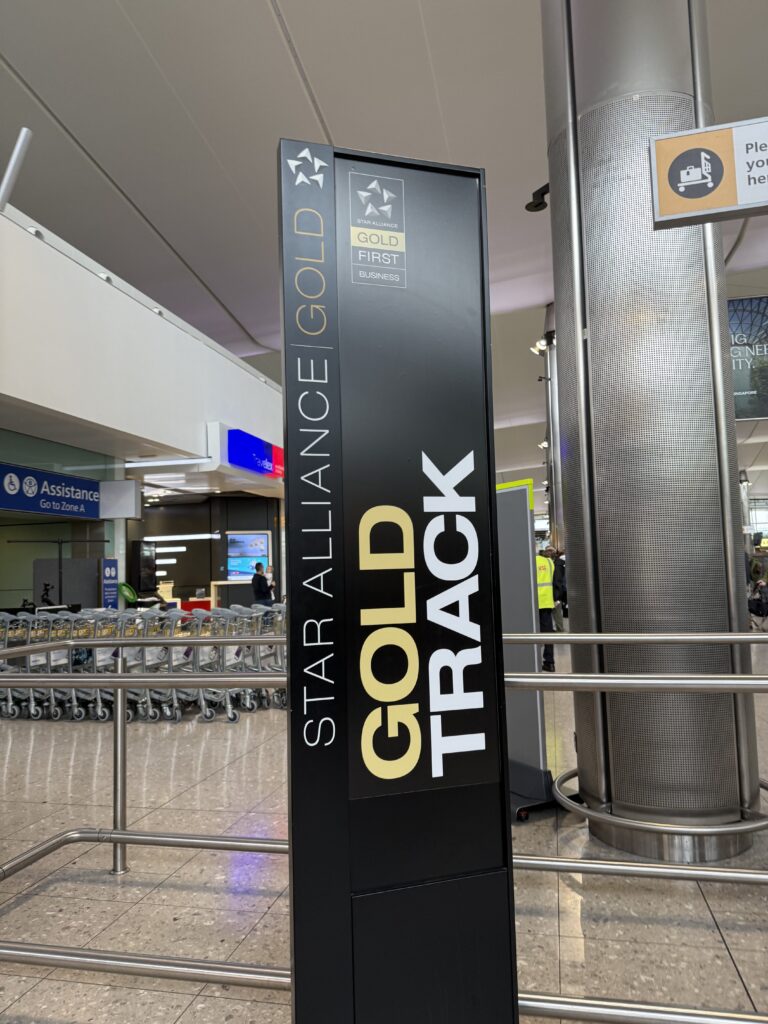
Star calls it Gold Track. It covers priority security at around 150 airports worldwide, plus immigration at a much smaller handful. Regional airports are well represented: Lufthansa’s list takes in Aberdeen, Bristol, Bergen, Billund, Faro, Malta, Salzburg and Thessaloniki alongside the obvious hubs.
Don’t look for a Gold Track sign, though. At many airports the lane carries its local name instead, so you’re hunting for Fast Track, Fast Lane, Priority Security or Express Path. Your Star Gold entitlement applies regardless of what the airport calls the lane.
Priority boarding
You board alongside business and first class passengers.
Priority baggage handling
Your bags get tagged for priority and come off the belt early. Unlike Oneworld, there’s no carve-out excluding a major member from this one.
Waitlist & standby priority
You go to the top of both lists. Award tickets are excluded, which catches out people flying on points.


What Star Alliance Gold doesn’t get you
First class lounges, in most cases. Gold gets you business class and frequent flyer lounges. The truly exclusive first class rooms, Lufthansa’s First Class Terminal in Frankfurt being the obvious one, sit outside the alliance benefit.
Waitlist and standby priority on award tickets. These two benefits exclude Star Alliance award bookings. Everything else still works on a points redemption, including lounge access, boarding, baggage and check-in.
Fast track everywhere. Coverage is broad, but some airports and terminals don’t extend their priority security lane to Star Alliance Gold.
Upgrades. Nothing in the alliance framework upgrades you. Individual programmes run their own upgrade schemes, and those are the airline’s gift.
Automatic benefits on non-member airlines. Star members codeshare widely outside the alliance, and your Gold card carries no automatic entitlement there. Connecting Partners and individual bilateral deals are the exceptions, so check the operating airline.
The fine print
- Connecting Partners aren’t full members. Juneyao Airlines participates as a Connecting Partner, and qualifying connected itineraries can carry selected alliance benefits. It’s a thinner arrangement than membership, so don’t assume full Gold treatment.
- Asiana is on a countdown. Star Alliance benefits continue through 16 December 2026. Mileage arrangements get complicated from 16 October, with different rules depending on whether you’re crediting an Asiana flight elsewhere or earning Asiana miles on another Star carrier, so check Asiana’s transition guidance before you fly.
- United Clubs have a rule of their own, and it bites MileagePlus members. If your Gold comes from United MileagePlus, status alone only gets you into a United Club in the US when you’re travelling in conjunction with a same-day international Star Alliance flight. A purely domestic trip doesn’t qualify.
- A paid airport Fast Track lane isn’t automatically yours. Eligibility depends on the arrangement your operating airline has with that airport.
- Aegean is about to move the goalposts. From 5 November 2026, the long-standing shortcut to Gold via Miles+Bonus gets significantly harder. Qualification becomes 32 Aegean or Olympic flights, or 24,000 tier miles including 12 such flights, or 72,000 tier miles with no flight requirement.
- Baggage depends on the fare, not just the tier. The extra allowance is subject to the operating airline’s fare rules, and some Basic and Light fares have their own restrictions.
How to get Star Alliance Gold status
Three routes: earn it with a home programme, run for it with a cheaper one, or take a status match.
Which programme suits you depends on where you fly, and we’ve compared them in the best Star Alliance frequent flyer programmes. For individual programme detail, we’ve reviewed Miles & More, United MileagePlus, Singapore KrisFlyer and Aegean Miles+Bonus. TAP has periodically offered status matches from programmes including BA, and we’ve run the numbers on whether it’s worth taking, although applications are currently closed.
BG1 verdict
Star Alliance Gold status packs the broadest set of useful airport benefits into one attainable tier. Business lounges and fast track come together, and that combination is the reason to chase it. Oneworld Emerald still beats it on first class lounges and first class check-in.
Chase it if you regularly fly Europe to Asia or North America, where Star Alliance has particularly useful coverage. Short-haul European flyers get decent value too, since Gold Track reaches a lot of regional airports. The real drawback is crowding, because there are plenty of Gold members competing for the same lounges – Lufthansa lounges get particularly crowded.
Our tip: Fast track is a benefit we value a lot. Check the Gold Track list for your home airport to find out if you have access.
Star Alliance Gold status FAQ
Is Star Alliance Gold the top tier? Yes. The alliance runs only Silver and Gold, so Gold is the highest reciprocal tier. There’s no Emerald equivalent above it.
Does Star Alliance Gold work in economy? Yes. Lounge access, the extra bag and priority boarding all apply regardless of your cabin, provided you’re flying a member airline.
Can I bring a guest into the lounge? One guest, holding a boarding pass for any Star Alliance flight leaving the same airport. They don’t need to be on your flight. Contract lounges are stricter and require your guest to be flying the same airline as you.
Do I get fast track everywhere? Not everywhere, but at around 150 airports, including many regional ones. Check the lane’s local name before you queue, because it’s often branded Fast Track or similar rather than Gold Track.
How does Gold compare to Oneworld Sapphire? Gold includes both business lounge access and fast track, while Oneworld splits those benefits between Sapphire and Emerald. Emerald still beats Gold on first class lounges and first class check-in.
What happens to Asiana status after December 2026? Asiana leaves the alliance at the end of 16 December 2026 as it merges into Korean Air. Mileage rules change before that, so anyone holding Asiana status or later bookings should check Asiana’s transition guidance directly.
Give us a follow on TikTok and Instagram.



Leave a Reply