I was poring over the seat map for a long-haul A321 the other week when something odd jumped out at me. The front row wasn’t simply the bulkhead with a bit more legroom. It was a different product altogether: bigger, doored, with its own name and its own fare. Business class, it turns out, now has a first class section. Airlines are quietly building a new tier into their long-haul cabins, one that sits somewhere between business and first. Nobody can quite agree on what to call it. The polite industry term is business class plus, and it is spreading fast.
What business class plus actually is
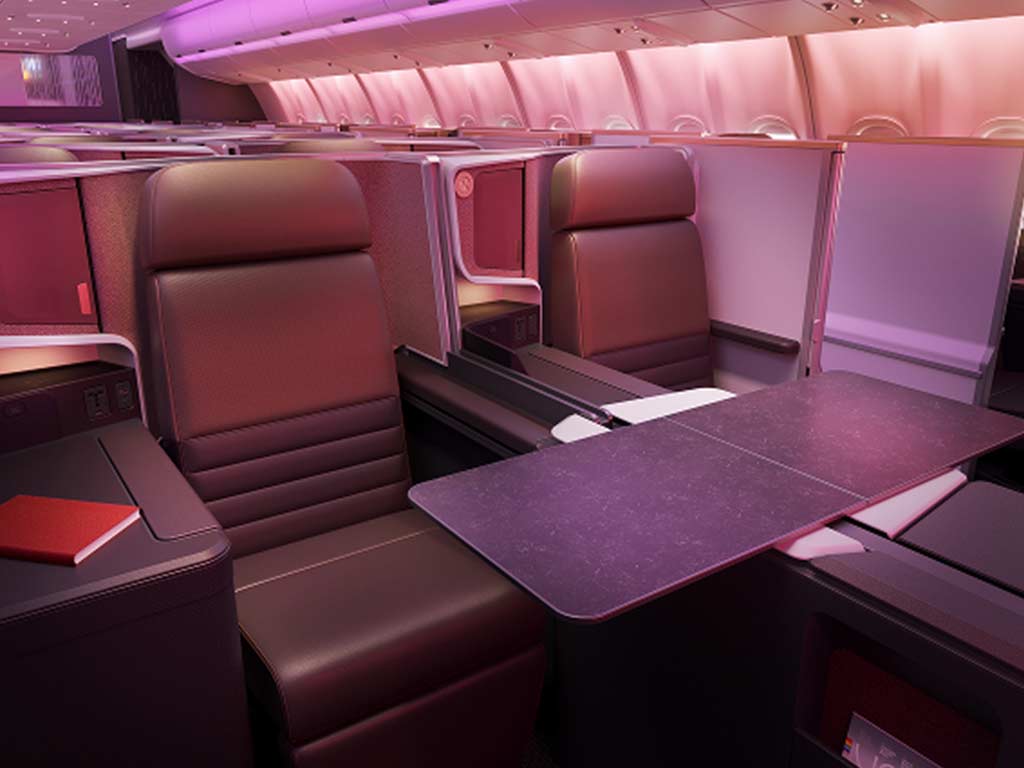
The recipe rarely changes. The standard seats in these new cabins are already lie-flat suites, often with sliding doors of their own. Up front, you take that same seat and supersize it: a roomier suite, buddy seating so a companion can join you, and upgraded soft product, amenities and food. Then you sell it as a step up. United calls its version the Polaris Studio. American went with Flagship Suite Preferred. JetBlue kicked the whole thing off with the Mint Studio on its single-aisle A321LRs. The badges differ, but the intent is identical, and the industry now files them under one heading: business class plus.
JetBlue Mint Premium Studio
Why the A321 drove the change
Here’s the part that makes this more than a gimmick. Airlines now fly narrowbodies like the A321LR and A321XLR on proper long-haul routes, thin city pairs that never justified a widebody. These jets are single-aisle. There’s no room for a separate first class cabin, and barely room for a grand business one. So the front-row upgrade becomes the most premium seat on the whole aircraft by default. That’s why business class plus was really born on the A321, not the 777.
Etihad took this to its logical end. On its A321LRs, it didn’t call the front row business class plus at all. It rebadged row 1 as first class, serving the actual first class menu to the front pair and piling on the soft product and ground treatment. Same hardware as a posh business seat, different label and a much bigger fare. One airline’s business plus is another airline’s first, which rather tells you how blurred this line has become.
The roll call
The widebodies are joining in too. United fits eight Polaris Studios on its newest 787-9s, each around 25% larger than a standard Polaris seat, with a 27-inch screen and an ottoman for a dining companion. American is busy retrofitting its 777s with Flagship Suite Preferred. Virgin Atlantic charges roughly £200 extra for a Retreat Suite on the A330neo, and it’s a good one. Air Canada is heading the same way, with bigger front-row Signature suites due on the 787-10 and the A321XLR.
Who kept first class & why
Here’s where the obituary writers get ahead of themselves. Not everyone is blurring the line. Lufthansa and Swiss kept first class and made it better, with proper enclosed suites under the Allegris and Swiss Senses banners. The Gulf giants and the big Asian carriers never wavered. These are airlines with the brand, the hubs and the dedicated first class terminals to fill a real first cabin, and they know it.
So first class isn’t dying everywhere. It’s splitting in two. The carriers that can fill four first seats at a fat fare keep them. The rest build business class plus and let the front row do that job instead.
A new class, or a clever ladder?
This is the bit I keep chewing over. Either this is a brand-new cabin class being born, a fifth tier slotting in between business and first, or it’s something craftier. The craftier reading goes like this. Airlines have worked out that one big leap from business to first is a hard sell, so they build a ramp instead. Premium economy nudges you up into business. Business class plus then nudges you a little further forward again. Each step feels small and affordable. Added together, they add up rather nicely on the balance sheet.
Riyadh Air is the detail that gives the game away. Back in 2023, before a single jet flew, the airline said it wouldn’t bother with first class at all. This is a carrier bankrolled by Saudi Arabia’s Public Investment Fund, hardly short of a few quid. Given a blank cheque and a clean sheet, it built a business cabin with four upgraded Business Elite suites at the nose, rather than a discrete first class. It chose the ramp.
Riyadh Air Business Elite front seat
Should you pay for business class plus?
It depends on when you plan to be awake. The real benefits of business class plus are daytime benefits: more room to stretch out and move about, a nicer soft product, and the buddy seat that lets you dine with a travelling companion. Stay conscious and you’ll get value from every penny.
Sleep through the flight, though, and you miss the lot. The lie-flat bed up front is the same hard product as the cheaper rows behind, so an overnight buys you a pricier suite you’ll snooze straight through. Worse, on a narrowbody the front row sits right behind the galley and the washroom. I’d question anyone booking row 1 of an A321 for a decent night’s kip. Go a few rows back for that and pocket the difference.
So my rule of thumb is simple. Business class plus earns its keep on daytime flights, the sort of daylight hops to the US and the Gulf where you’re up and about for most of it. Pay the premium then, within reason. On an overnight, save your money. And if you actually want the real thing, fly the handful of carriers still brave enough to sell it, Etihad first, Swiss and the usual Gulf suspects.
First class isn’t dead, then. The wall between business and first is the thing quietly coming down, replaced by a gentle ramp of ever-pricier seats. Whether business class plus settles into a genuine class of its own, or stays a clever way to walk you forward one upgrade at a time, the answer will come soon enough. Either way, the four tidy cabin classes are turning into a sliding scale.


I was poring over the seat map for a long-haul A321 the other week when something odd jumped out at me. The front row wasn’t simply the bulkhead with a bit more legroom. It was a different product altogether: bigger, doored, with its own name and its own fare. Business class, it turns out, now has a first class section. Airlines are quietly building a new tier into their long-haul cabins, one that sits somewhere between business and first. Nobody can quite agree on what to call it. The polite industry term is business class plus, and it is spreading fast.
What business class plus actually is
The recipe rarely changes. The standard seats in these new cabins are already lie-flat suites, often with sliding doors of their own. Up front, you take that same seat and supersize it: a roomier suite, buddy seating so a companion can join you, and upgraded soft product, amenities and food. Then you sell it as a step up. United calls its version the Polaris Studio. American went with Flagship Suite Preferred. JetBlue kicked the whole thing off with the Mint Studio on its single-aisle A321LRs. The badges differ, but the intent is identical, and the industry now files them under one heading: business class plus.
Why the A321 drove the change
Here’s the part that makes this more than a gimmick. Airlines now fly narrowbodies like the A321LR and A321XLR on proper long-haul routes, thin city pairs that never justified a widebody. These jets are single-aisle. There’s no room for a separate first class cabin, and barely room for a grand business one. So the front-row upgrade becomes the most premium seat on the whole aircraft by default. That’s why business class plus was really born on the A321, not the 777.
Etihad took this to its logical end. On its A321LRs, it didn’t call the front row business class plus at all. It rebadged row 1 as first class, serving the actual first class menu to the front pair and piling on the soft product and ground treatment. Same hardware as a posh business seat, different label and a much bigger fare. One airline’s business plus is another airline’s first, which rather tells you how blurred this line has become.
The roll call
The widebodies are joining in too. United fits eight Polaris Studios on its newest 787-9s, each around 25% larger than a standard Polaris seat, with a 27-inch screen and an ottoman for a dining companion. American is busy retrofitting its 777s with Flagship Suite Preferred. Virgin Atlantic charges roughly £200 extra for a Retreat Suite on the A330neo, and it’s a good one. Air Canada is heading the same way, with bigger front-row Signature suites due on the 787-10 and the A321XLR.
Who kept first class & why
Here’s where the obituary writers get ahead of themselves. Not everyone is blurring the line. Lufthansa and Swiss kept first class and made it better, with proper enclosed suites under the Allegris and Swiss Senses banners. The Gulf giants and the big Asian carriers never wavered. These are airlines with the brand, the hubs and the dedicated first class terminals to fill a real first cabin, and they know it.
So first class isn’t dying everywhere. It’s splitting in two. The carriers that can fill four first seats at a fat fare keep them. The rest build business class plus and let the front row do that job instead.
A new class, or a clever ladder?
This is the bit I keep chewing over. Either this is a brand-new cabin class being born, a fifth tier slotting in between business and first, or it’s something craftier. The craftier reading goes like this. Airlines have worked out that one big leap from business to first is a hard sell, so they build a ramp instead. Premium economy nudges you up into business. Business class plus then nudges you a little further forward again. Each step feels small and affordable. Added together, they add up rather nicely on the balance sheet.
Riyadh Air is the detail that gives the game away. Back in 2023, before a single jet flew, the airline said it wouldn’t bother with first class at all. This is a carrier bankrolled by Saudi Arabia’s Public Investment Fund, hardly short of a few quid. Given a blank cheque and a clean sheet, it built a business cabin with four upgraded Business Elite suites at the nose, rather than a discrete first class. It chose the ramp.
Should you pay for business class plus?
It depends on when you plan to be awake. The real benefits of business class plus are daytime benefits: more room to stretch out and move about, a nicer soft product, and the buddy seat that lets you dine with a travelling companion. Stay conscious and you’ll get value from every penny.
Sleep through the flight, though, and you miss the lot. The lie-flat bed up front is the same hard product as the cheaper rows behind, so an overnight buys you a pricier suite you’ll snooze straight through. Worse, on a narrowbody the front row sits right behind the galley and the washroom. I’d question anyone booking row 1 of an A321 for a decent night’s kip. Go a few rows back for that and pocket the difference.
So my rule of thumb is simple. Business class plus earns its keep on daytime flights, the sort of daylight hops to the US and the Gulf where you’re up and about for most of it. Pay the premium then, within reason. On an overnight, save your money. And if you actually want the real thing, fly the handful of carriers still brave enough to sell it, Etihad first, Swiss and the usual Gulf suspects.
First class isn’t dead, then. The wall between business and first is the thing quietly coming down, replaced by a gentle ramp of ever-pricier seats. Whether business class plus settles into a genuine class of its own, or stays a clever way to walk you forward one upgrade at a time, the answer will come soon enough. Either way, the four tidy cabin classes are turning into a sliding scale.
Read next: The 6 Leading Business Class Seat Types
Why not follow us on TikTok and Instagram, or Sign-up for our Weekly Newsletter.
Related Articles
British Airways New A380 First Class Hides 88 Missing Economy Seats
American Airlines Opens Flagship Dining to Business Class
Emirates Wine Cellar Onboard: Serious Investment or Great PR?
Heathrow Third Runway: Futureproof Against What?